What Is Hidden In Plain Sight in U.S. Census Records
A Practical Guide to Commonly Overlooked Census Columns

If you have searched for an ancestor on Ancestry or FamilySearch, pulled up a census image, jotted down the name, age, birthplace, and occupation, and moved on to the next record, you have done what most genealogists do with the census, and you have left most of the record’s information behind on the page. The handful of fields that everyone records represent only a fraction of what the enumerator was required to collect, and the columns that get skipped are often the ones that point you toward ship passenger lists, naturalization papers, military pension files, deed records, and death records that you would not have known to look for otherwise.
This is not a catalog of every census question ever asked. It is a working method for recognizing the columns most likely to lead you to other records, and for using the census as a research-planning tool rather than a simple name-and-date lookup. It covers the overlooked columns on the population schedule, the nonpopulation schedules that most researchers have never searched, the state and territorial censuses that fill the gaps between federal enumerations, and the analytical techniques that turn a census page from a single data point into a window onto an ancestor’s community and social world.
The federal census provides a recurring snapshot of American families at regular ten-year intervals, free through FamilySearch or through a subscription to Ancestry, MyHeritage, or Findmypast. Related schedules, state censuses, and territorial enumerations vary more in their availability, but the core population schedules are within reach of anyone with an internet connection and a free FamilySearch account.
Understanding the Census Date
Before working through individual columns, one preliminary concept applies to every census entry you will ever read: each census has an official census date, and all of the information in the record is supposed to reflect conditions as of that date, not the day the enumerator showed up at the door.
The official dates are June 1 for the 1850 through 1900 censuses, April 15 for 1910, January 1 for 1920, and April 1 for 1930 through 1950. A child born after the census date but before the enumerator’s visit should not have been included in the household, and a person who died after the census date but before the enumerator arrived should still appear on the schedule. Keeping the official census date in mind will save you from miscalculating birth years and misinterpreting who should and should not appear in a given household.
The Overlooked Columns on the Population Schedule
The fields everyone records from a census entry are name, age, sex, birthplace, occupation, and (from 1880 onward) the relationship to the head of household. But the Census Bureau required enumerators to ask a much longer list of questions in every decade, and the columns that collect dust are the ones that do the most work in connecting you to other records.
The Relationship Column and How to Read It
From 1880 onward, each person in a household is listed in relation to the head of household, not in relation to the person on the line above them. A “daughter” listed after a “wife” is the head’s daughter, and not necessarily the wife’s daughter, and a “mother” listed in the household is the head’s mother, not the wife’s. Every relationship term on the page, whether “step-son,” “mother-in-law,” or “half-sister,” is defined from the perspective of the head and no one else. Misreading this column causes the most damage in blended households where step-children, in-laws, and relatives from a previous marriage are all living under one roof. When you encounter a household with more than a simple nuclear family, take a moment to diagram who is related to whom through the head rather than assuming the listing order implies parent-child relationships between adjacent lines.
Birthplace Columns and Immigrant Generations
The birthplace columns evolved over the decades and grew more specific as immigration became a larger concern for the Census Bureau. The 1870 census included columns asking whether each person’s father or mother was “of foreign birth,” recorded with nothing more than a check mark or a blank. These columns are easy to skip because the marks are small and the information seems minor, but for anyone researching families in the transition between immigration and assimilation, they confirm which generation made the crossing and tell you to focus your search for passenger records and naturalization papers on the parents’ generation rather than your ancestor’s.
The 1880 census expanded on this by asking for the specific birthplace of each person’s father and mother, giving you two additional data points that can confirm national origin even when the person themselves was born in the United States. From 1900 onward, the immigration and naturalization columns (discussed below) added still more detail, but the earlier birthplace columns remain useful for the decades they cover, and they are worth checking when later entries for the same family are missing or too damaged to read.
Literacy and Education (1850 Through 1940)
The literacy and education columns asked whether each person could read and write, whether they had attended school within the census year, and (on the 1940 schedule) what the highest grade of school completed was. These columns serve two purposes in your research: they help you distinguish between people who share a name in the same area, and they help you predict what other records are likely to exist.
An illiterate farmer and a literate merchant both named John Smith living in the same county in 1860 may be two different people, and those details should keep you from merging them too quickly. Literacy also tells you something about the kinds of documents your ancestor would have produced or appeared in, since a literate ancestor is more likely to show up in newspaper records, organizational membership rolls, and probate records with a written will, while an illiterate ancestor’s mark or X on a legal document becomes a useful identifying feature when you encounter it in court or land records.
Children Born and Children Living (1900 and 1910)
The 1900 and 1910 censuses asked every married woman two questions that most researchers skip past: how many children she had given birth to over her lifetime, and how many of those children were still alive at the time of the census. The difference between those two numbers is a count of children who died before the census date, whether or not you have ever seen their names in any other record.
If a woman reports eight children born and four living, you know that four children died, and your picture of that family is incomplete until you have accounted for all of them. These columns are among the most underused in American genealogy, and they are the only standard federal population census entries that give a direct count of how many children a woman reported bearing, including children who may have died in infancy and left no trace in household records. When you record an entry from the 1900 or 1910 census, always note both numbers and the gap between them, because that gap defines how much of the family you have yet to find.
Immigration and Naturalization (1900 Onward)
Starting in 1900, the census asked foreign-born residents what year they arrived in the United States and whether they had been naturalized, had filed their first papers (a declaration of intention), or remained aliens. The abbreviations vary by decade (”Na” for naturalized, “Pa” for first papers, “Al” for alien are the most common), and you should always read the abbreviations from the column headings on the original schedule rather than assuming them from memory, because the codes and the form of the question changed from one census to the next.
These fields point you directly to two other record sets: passenger arrival manifests and naturalization court records. An ancestor who reported arriving in 1882 and being naturalized should have both a ship record around that year and a naturalization file in the courts of the county where they lived, and an ancestor who reported first papers only tells you to look for a declaration of intention rather than a completed naturalization. Naturalization records are worth the search because they often contain the ancestor’s specific town of origin overseas, a physical description, and the names of witnesses who may be relatives or associates from the same community back home.
The 1920 census stands out here because it is the only federal census that asked for the year of naturalization itself, not just whether the person was naturalized. If your ancestor’s 1920 entry shows “Na” with a year, you have a specific date to use when searching court records, which makes the 1920 census the single most useful census for targeting a specific naturalization file.
Home Ownership and Property Value
The home ownership columns changed form across the decades but always carried information that connects to county-level records. The 1850, 1860, and 1870 censuses recorded the dollar value of real estate owned. From 1900 through 1940, the census asked whether the dwelling was owned or rented, and the 1900, 1910, and 1920 censuses added a column for whether an owned property was held free and clear or carried a mortgage. The 1930 and 1940 censuses replaced the mortgage question with a column for the dollar value of the home (if owned) or the monthly rent (if rented).
What makes these columns worth tracking across decades is that changes in property status point you to other records. A family that rented in 1900 but owned in 1910 likely generated a land or deed record in the intervening decade, usually held at the county level. A family that owned a mortgaged property in 1920 but appears as renters in 1930 may have lost their home during the economic collapse of the late 1920s, and the circumstances of that loss could be documented in county court or foreclosure records.
Age at First Marriage (1930)
The 1930 census included a column for the age at first marriage that most researchers pass over. If you know the person’s current age from the same line and their age at first marriage, you can calculate an approximate marriage year, and that approximate year lets you target your search for a marriage record to a narrow range of dates rather than searching blindly through decades of county volumes. This column also helps you determine whether a current marriage is a first or subsequent union, which matters when you are trying to sort out blended households and figure out which children belong to which marriage.
Veteran Status (1910, 1930, 1940)
The 1910 census asked whether the respondent was a survivor of the Union or Confederate Army or Navy (recorded as UA, UN, CA, or CN). The 1930 census asked about service in any war or expedition, using abbreviations like CW for the Civil War, Sp for the Spanish-American War, and WW for the First World War. The 1940 census included veteran status among the supplemental questions asked of a sample of the population.
These columns point to military service records and pension files, which often contain physical descriptions, family information, and service histories that no other source preserves. A veteran indicator in the census for which you have no corresponding military record represents a gap in your research worth pursuing.
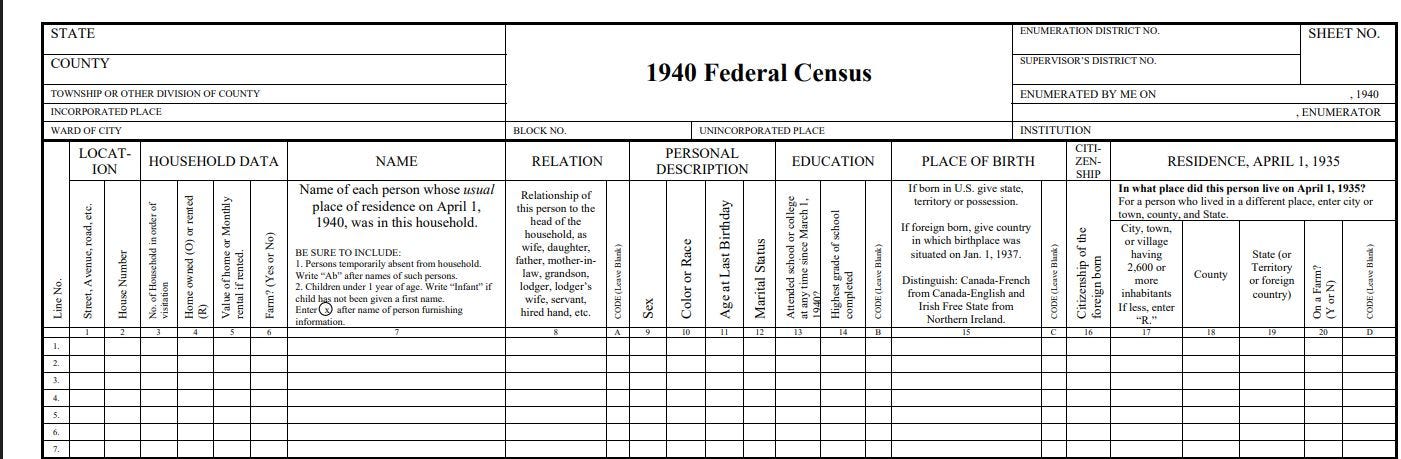
The 1940 Census: Who Told the Enumerator, and Where Were They in 1935
The 1940 census has two features that no other federal census shares.
The first is the informant mark: enumerators were instructed to write a circled X after the name of the person who provided the household’s information, and when the information came from someone outside the household (a neighbor, for example), the informant’s name was supposed to be written in the left margin. This matters because it lets you evaluate how reliable the data is for each household. If an ancestor’s teenage grandchild provided the information, the birthplace and immigration data for the grandparents may be secondhand or approximate, while self-reported data from the head of household carries more weight. No other federal census identifies the informant, so when you see discrepancies between a 1940 entry and earlier censuses, checking the informant mark is the first step in figuring out why.
The second feature is the question about where each person age five and older lived on April 1, 1935, recorded as a city, county, and state or as “same place.” This is one of the best migration clues in the entire census system because it bridges the ten-year gap between the 1930 and 1940 enumerations with a specific midpoint location.
The 1950 Census
The 1950 census, made public in 2022, is the most recently released federal census. Because it was released only a few years ago, indexes and search tools have improved rapidly, but researchers should still be willing to browse images when a name search fails. It includes occupation, a question about where the person lived one year earlier (in 1949, providing another migration data point), and a sample-line system in which every fifth person on the schedule was asked supplemental questions covering income, education, veteran status, and fertility. If your ancestor fell on a sample line (lines 14 and 29 of each sheet), you have access to information that the standard entries do not include, and it is worth checking the line number before assuming the census has nothing beyond the basic fields.
The Nonpopulation Schedules
When genealogists search the census, they are searching the population schedule, but the population schedule was only one of several documents the Census Bureau required enumerators to complete during a given census year. The others, known collectively as the nonpopulation schedules, survive for various years between 1850 and 1880 and contain information that appears nowhere else in the federal record system. The slave schedules and the 1890 veterans schedule discussed at the end of this section are not nonpopulation schedules in the strict Census Bureau sense (they are population-related enumerations), but they are part of the broader census system and are included here because they are accessed and used the same way.
Mortality Schedules (1850, 1860, 1870, 1880, and Some 1885 State Schedules)
The mortality schedules attempted to record every person who died in the twelve months before the official census date, and each entry includes the name of the deceased, age, sex, color, birthplace, occupation, cause of death, and month of death. In many parts of the country, these schedules predate the establishment of civil death registration by decades, making them the only official record of a death during the period they cover.
They were not perfectly comprehensive, and undercounting was a real problem in rural areas where informants did not always report every death, but they remain an important source when an ancestor appears in one census and is absent from the next. If the years between those two censuses fall within the mortality schedule window, these records should be one of your first stops. They are indexed and available on both Ancestry and FamilySearch.
Agricultural Schedules (1850, 1860, 1870, 1880)
The agricultural schedules recorded detailed information about each farm in an enumeration district: the name of the owner or manager, the number of improved and unimproved acres, the cash value of the farm and its machinery, the number and type of livestock, the bushels of each crop produced, and the value of animals slaughtered during the preceding year. If your ancestor was a farmer, and a very large proportion of Americans before 1900 were, this schedule transforms a bare occupation listing into a full economic portrait that tells you what they grew, how many animals they kept, how much their land was worth, and how their operation compared to the farms around them. Many surviving agricultural schedules are available through Ancestry, FamilySearch, and state archives, but coverage varies by state and year.
Manufacturing, Social Statistics, and 1880 Supplemental Schedules
The manufacturing and industry schedules (1820, 1850 through 1880) documented businesses, mills, and other enterprises, recording the type of business, capital invested, number of employees, raw materials, and annual value of products. The social statistics schedules (1850 through 1880) recorded information about churches, schools, libraries, newspapers, taxes, wages, and cemeteries within each enumeration area, and while they will not tell you about a specific individual, they can tell you what institutions existed in your ancestor’s community during the years your family lived there. The 1880 supplemental schedules recorded individuals identified as blind, deaf, paupers, prisoners, or homeless children, using the terminology of the period, and can matter when an ancestor was institutionalized or living outside a standard household. These three schedule types apply to fewer researchers than the mortality and agricultural schedules, but they are worth checking when they are relevant to your family’s circumstances.
The Slave Schedules (1850 and 1860)
The slave schedules recorded the name of each slaveholder along with the age, sex, and color of each enslaved person held, but did not record the names of the enslaved individuals. Despite that limitation, they remain an important resource for African American genealogy because they can help narrow which slaveholder held individuals matching the age, sex, and other characteristics of ancestors who appear by name for the first time in the 1870 census.
These matches should be treated as working hypotheses rather than conclusions, because the path from a slave schedule match to an identified ancestor almost always runs through additional records: probate inventories, deeds, plantation records, Freedmen’s Bureau files, Freedman’s Bank records, labor contracts, cohabitation registers, church records, and court documents.
The 1890 Veterans Schedule
The population schedules of the 1890 census were almost entirely destroyed in a 1921 fire at the Commerce Department building, but one related enumeration survived in part: the “Special Schedules of the Eleventh Census Enumerating Union Veterans and Widows of Union Veterans of the Civil War.” The schedules for states alphabetically from Alabama through Kansas and roughly the first half of Kentucky were destroyed before the records reached the National Archives in 1943, but the schedules for the remaining portion of Kentucky through Wyoming survive, along with those for the District of Columbia and fragments from a handful of other states. For veterans in the surviving states, this schedule records rank, company, regiment, dates of enlistment and discharge, length of service, and any disability incurred, and it places the veteran in a specific location in 1890, which is the only way to document where someone was living during that otherwise lost decade.
State and Territorial Censuses
The federal census is taken every ten years, and the gaps between enumerations can cover an entire generation’s worth of births, marriages, migrations, and deaths. Dozens of states conducted their own censuses to fill those gaps, often at the five-year midpoint between federal enumerations, and many of them asked questions that the federal census never did.
The most extensive state census programs were in New York (1825, 1835, 1845, 1855, 1865, 1875, 1892, 1905, 1915, and 1925), Iowa (1856, 1885, 1895, 1905, 1915, and 1925), and Kansas (1865, 1875, 1885, 1895, 1905, 1915, and 1925). Minnesota, Wisconsin, Rhode Island, New Jersey, and several other states also conducted censuses at various intervals, and a complete list of known state census records is maintained on the FamilySearch Wiki.
The value of state censuses goes well beyond filling in the years between federal enumerations. The 1855 and 1865 New York state censuses recorded the county of birth for New York natives, a level of geographic specificity that no federal census ever provided. The 1925 Iowa state census recorded the mother’s maiden name and the place where the parents were married, information that is otherwise very hard to find in any single record. Rhode Island’s 1865 state census recorded the specific town of birth. The 1865 state censuses of Minnesota, New York, and Rhode Island included columns for military service, documenting Civil War veterans decades before any similar question appeared on a federal census form. Kansas state censuses recorded where each person had come from before arriving in Kansas, providing migration data that the federal schedules do not contain.
State censuses are also the best tool for bridging the gap created by the destruction of the 1890 federal census. New York’s 1892 census, the 1895 censuses conducted by Iowa, Kansas, Minnesota, and Wisconsin, and similar records from other states can place ancestors in specific locations during the years that the federal record cannot account for.
Before statehood, many territories conducted their own enumerations, and these territorial censuses can extend research into periods that predate both state and federal census coverage. Territorial censuses exist for Kansas, Nebraska, New Mexico, Arizona, Washington, Oregon, Colorado, Dakota Territory, and others, and they are often available on FamilySearch.
City Directories
City directories are not census records, but they function as annual quasi-censuses for urban ancestors and pair so well with census research that they belong in any discussion of how to use the census system. Published annually for most American cities from the early nineteenth century onward, they listed residents by name along with their occupation and address, and many also included a business directory and a street directory that can help you reconstruct a neighborhood.
Because city directories were published every year rather than every ten, they fill the gaps between census enumerations with annual snapshots that can track an ancestor’s movements, occupation changes, and household composition from year to year. A person who appears at one address in the 1900 census and a different address in the 1910 census may have moved several times in between, and city directories can document each move. Large collections of digitized city directories are available on Ancestry, the Internet Archive, and in public library digital collections.
Finding Missed Entries: Soundex, Miracode, and Enumeration Districts
Sometimes you know an ancestor should be in a given census but cannot find them through a standard name search. Three tools can help.
The Soundex and Miracode card systems are microfilmed card indexes organized by a phonetic coding system that groups similar-sounding surnames together. Soundex cards exist for the 1880 census (households with children age ten and under only), the 1900 census (all households), the 1910 census (selected states only), and the 1920 census (all states), and the 1930 census uses a related system called Miracode for selected states. Each card contains a summary drawn from the census entry, including the head of household’s name, age, birthplace, citizenship status, state, county, and city of residence, along with the volume, enumeration district, sheet, and line number needed to locate the original page. Because the system groups surnames by how they sound rather than how they are spelled, it can find ancestors whose names were recorded with unexpected spelling variations that a standard alphabetical search would miss. FamilySearch and Ancestry both provide Soundex calculators.
From 1880 onward, the Census Bureau divided the country into enumeration districts, each assigned to a single enumerator, and descriptions and maps of those districts can help you reconstruct the physical area an enumerator covered. If you have an ancestor’s address from a city directory, a deed, or a neighboring census year, the Steve Morse One-Step website at stevemorse.org provides a Unified Census ED Finder that converts a known address into an enumeration district number for census years from 1880 to 1950, letting you go directly to the right pages and read them line by line. This is one of the most effective methods for locating ancestors who are in the census but not in the index.
Reading the Neighborhood
The most productive census research technique that most introductory genealogy courses do not teach is cluster research: reading not just your ancestor’s entry on a census page but the entries of the families listed around them, and tracking those neighboring families across multiple census years.
Census enumerators walked or rode door to door through their assigned districts, and in many cases, the families listed immediately above and below your ancestor were nearby households, though enumeration order should always be checked against maps, deeds, directories, and local geography rather than assumed to mean direct adjacency. The neighborhood recorded on a census page is a map of your ancestor’s social world, and it can answer questions that no amount of name-based searching will resolve.
Families in the eighteenth and nineteenth centuries rarely migrated alone. They moved in clusters of related families, families from the same church congregation, families from the same European village or American county of origin, and when a family from Virginia appears in Kentucky in 1810, it is common to find that several of their former Virginia neighbors settled in the same Kentucky county within a few years. If you cannot figure out where your ancestor came from before appearing in a new location, identifying their neighbors and tracing those neighbors backward through earlier records may lead you to the county, parish, or community your own family left behind. Neighbors intermarried more often than modern researchers tend to assume, witnessed each other’s legal documents, attended the same churches, and were buried in the same cemeteries, and once you have identified the recurring names in your ancestor’s neighborhood, you can search the records of those families for references to your own.
When you locate your ancestor on a census image, do not close the page. Read the full sheet and record the names, ages, birthplaces, and occupations of the five to ten families listed before and after your ancestor’s household, then check whether any of those same families appear near your ancestor in earlier or later census years. Families that show up as neighbors across multiple decades are almost certainly connected by kinship, shared religious affiliation, or common geographic origin, and their records can open research paths that your own family’s records alone cannot.
What Enumerator Errors Tell You
Census records contain errors, and every genealogist encounters them, but the errors themselves are data if you understand why they happen and what they reveal.
The census was collected by a single enumerator who walked door to door and recorded whatever the person who answered the door told them. If nobody was home, the enumerator was supposed to return but in practice sometimes got the information from a neighbor. If a child or a boarder answered the door instead of the head of household, the information they provided about other family members may reflect what they knew, guessed, or assumed rather than what the absent members would have said about themselves. Ages were routinely rounded (a phenomenon demographers call “age heaping,” where ages cluster at numbers ending in zero or five), birthplaces were sometimes given at a level of generality that obscured the real place of origin (”Germany” rather than “Bavaria,” “Ireland” rather than “County Cork”), and names were filtered through the enumerator’s ear, accent, and spelling before reaching the page.
This means that discrepancies between census entries across different decades are not signs that a record is wrong but are data points in their own right. If your ancestor’s birthplace shifts between census years, the shift may reflect a change in who provided the information, or it may reflect the ancestor’s own shifting presentation of identity in response to social pressures, as when immigrants sometimes claimed native birth during periods of nativist hostility. Spelling variations in surnames across census decades are evidence of how the name sounded to different enumerators over time, and the range of recorded spellings can tell you something about the family’s accent, regional origin, and degree of literacy, since literate families tended to correct enumerators while illiterate families could not.
A Worked Example
To see how these columns work together in practice, consider a 1910 census entry for a woman who reports six children born and three living, a husband listed as naturalized with an arrival year of 1889, a rented home, and a neighboring household that shares her maiden surname. Those four observations create four research tasks: find the three missing children through mortality schedules, church death records, or cemetery records; search naturalization court records and passenger arrival lists using the husband’s year of arrival; look for a deed record in a later decade if the family transitions from renting to owning; and trace the neighboring household to determine whether the shared surname indicates relatives who may have migrated together. A single census line, read in full, has just generated a research plan that could take weeks to complete and may connect you to records in three or four different repositories.
Putting It All Together
Start by building a checklist of every census in which your ancestor should appear: federal censuses for every decade from birth to death, state censuses conducted by the states where your ancestor lived, territorial censuses that predate statehood, and city directories for ancestors who lived in towns or cities.
For each census on your checklist, search for the ancestor and read every column, not just the familiar fields but also the literacy, immigration, property, veteran, marriage, and fertility columns that point to other record sets. For every census entry, read the full page and record the neighboring households, then check whether those same neighbors appear near your ancestor in other census years. Check the nonpopulation schedules for any ancestor who was alive between 1850 and 1880.
When comparing entries across decades, build a table that tracks not just the individual ancestor but the entire household structure: missing children, new elderly relatives, boarders, servants, step-children, widowed in-laws, surname changes among women in the household, and nearby households that share a surname with your family. Comparing whole households across census years reveals far more than tracking a single individual, because the appearance and disappearance of household members is itself evidence of marriages, deaths, economic changes, and family separations that may not be documented anywhere else.
Each discrepancy in that table is a question worth pursuing: a birthplace that changes, an age that does not advance correctly, a child present in one census but absent from the next, a shift from owning to renting or the reverse. The answers to those questions, when followed through other record sets, are where the most important findings tend to come from. The census does not just tell you who was in the household. Read properly, it tells you what to search next.
Sources
National Archives, “Clues in Census Records, 1850-1950.” archives.gov/research/census/1850-1950.
National Archives, “Nonpopulation Census Records.” archives.gov/research/census/nonpopulation.
National Archives, “1890 Census.” archives.gov/research/census/1890.
National Archives, “1940 Census: General Information.” archives.gov/research/census/1940/general-info.
National Archives, “20 Tips for Census Research Success.” archives.gov.
National Archives, “Maps at NARA of Interest to Genealogists.” archives.gov/research/genealogy/maps.
U.S. Census Bureau, “1890 Veterans Census.” census.gov.
U.S. Census Bureau, “Nonpopulation Records.” census.gov.
U.S. Census Bureau, “1900 Census Instructions to Enumerators.” census.gov.
U.S. Census Bureau, “1940 Census Instructions to Enumerators.” census.gov.
FamilySearch Wiki, “Census Techniques and Strategies for Finding Elusive Ancestors.” familysearch.org.
FamilySearch Wiki, “United States State Census Records.” familysearch.org.
FamilySearch Wiki, “United States Census Veterans Schedules.” familysearch.org.
FamilySearch Wiki, “United States Census Soundex and Miracode.” familysearch.org.
Steve Morse One-Step Website, Unified Census ED Finder. stevemorse.org.
Family Tree Magazine, “The Genealogist’s Guide to Special US Census Schedules.” familytreemagazine.com.
Family Tree Magazine, “Extra Ancestor Clues in US Census Records.” familytreemagazine.com.
Family Tree Magazine, “Enumeration District Maps: How to Use Them in Your Genealogy Research.” familytreemagazine.com.
Amy Johnson Crow, “5 Hidden Clues in the US Census.” amyjohnsoncrow.com.
American Ancestors/Vita Brevis, “Hidden Gems in State Census Records.” vitabrevis.americanancestors.org.
Thanks
Thank you for this!