How To Read Cyrillic Records
A Genealogist’s Guide to Reading Slavic Cyrillic Records

Many family historians follow a line back through the English-language records, across the ocean into the parish books and tax lists of the old country, and then halt at the page where the writing changes alphabets. The usual reason they stop is the belief that the records are closed to them unless they first learn the language, and that learning a Slavic language well enough to read nineteenth-century handwriting is the work of years. The belief is mistaken, and acting on it keeps researchers from ancestors who are already documented on the page in front of them.
You do not need to know any Slavic language to read the names, dates, and relationships off a Cyrillic record. What you need is recognition: the shape of the alphabet, a small set of recurring words, and the ability to tell one tradition’s script from the next. These records were repetitive by design. A clerk filling a baptismal register in 1860 was completing the same ruled columns, in the same order, with the same two dozen words that every other clerk in the district was using that year. The genealogical facts you want sit in predictable positions and are surrounded by vocabulary that repeats on every line. Learn the letters, a short working vocabulary, and the shape of three or four record types, and most of the page opens up.
Where Cyrillic Came From
The script is called Cyrillic in English, pronounced “si-RIL-ik” with the stress on the second syllable. In Russian it is кириллица (kirillitsa, “ki-RIL-li-tsa”), and the equivalent in the other Slavic languages is close enough that a researcher will recognize it on sight. The name honors Saint Cyril, one of two missionary brothers from Byzantine Thessalonica who in the ninth century were sent north to bring Christianity to the Slavic peoples of Central Europe.
The Slavs at that time had no written script of their own, and the church needed a way to translate scripture and the liturgy into Slavic so the new converts could understand the services. Around 863, Cyril and his brother Methodius created a first alphabet for this purpose, called Glagolitic, with letter shapes loosely inspired by Greek but visually distinct enough to be its own system. Glagolitic remained important in some regions, but the later Cyrillic fit more naturally into the Greek-trained scribal world that shaped Bulgarian and East Slavic church writing.
After Cyril’s death in 869 and the political defeat of the mission in Moravia, his disciples regrouped in the First Bulgarian Empire under royal patronage. In the literary centers there, often associated with Preslav and the late ninth century, a second alphabet took shape, this one built more directly on Greek uncial letters with new shapes added for the Slavic sounds Greek did not have. This second alphabet was named Cyrillic in honor of Cyril, even though Cyril himself almost certainly never used it. It was the practical, scribe-friendly version of his project, and it spread quickly.
From Bulgaria the alphabet moved with Orthodox Christianity in every direction. It reached Kievan Rus’ with the conversion of 988 and became the writing system of the East Slavs. It traveled south through Serbia and into the Romanian principalities for several centuries. Each region adapted the alphabet slowly over time, dropping letters they did not need and adding letters they did. The single biggest reform was Peter the Great’s redesign in 1708, which gave Russia and most of its Cyrillic-using neighbors the rounded, modern-looking civil script described later in this article. From there the alphabet kept evolving in each Slavic country into the modern forms a researcher meets in records today.
One thing to settle right away: Cyrillic is a script, not a language and not a religion. No one speaks Cyrillic, because there is no Cyrillic language; the script is a shared writing system used to record Russian, Ukrainian, Belarusian, Bulgarian, Serbian, Macedonian, and several non-Slavic languages besides. Greek Catholic records sometimes used Cyrillic or Church Slavonic, while others were kept in Latin, Polish, Hungarian, German, Romanian, or other administrative languages depending on place and period. Civil, military, and tax records across the Russian Empire used Cyrillic Russian. Jewish vital records in the Russian Empire are typically in Russian, often with Hebrew or Yiddish parallel entries or marginalia depending on the period and the locality. Recognizing the script tells you which alphabet is on the page, and nothing more; the church or state authority that produced the record, and the language inside it, are separate questions you settle from other evidence.
The Alphabet Itself
Start with the printed alphabet, because printed Cyrillic gives most readers little trouble after a short period of practice. The handwriting is harder, and we come to it below, but you cannot read the cursive until you know what the letters are supposed to be.
The most useful way to meet the alphabet is in three groups: the letters that behave the way you expect, the handful of “false friends” that look like Latin letters but do something else, and the genuinely new shapes you simply have to learn.
The easy ones look like Latin letters and sound roughly the way they look: А (a), Е (e, or ye at the start of a word), К (k), М (m), О (o), and Т (t). You can read these on sight.
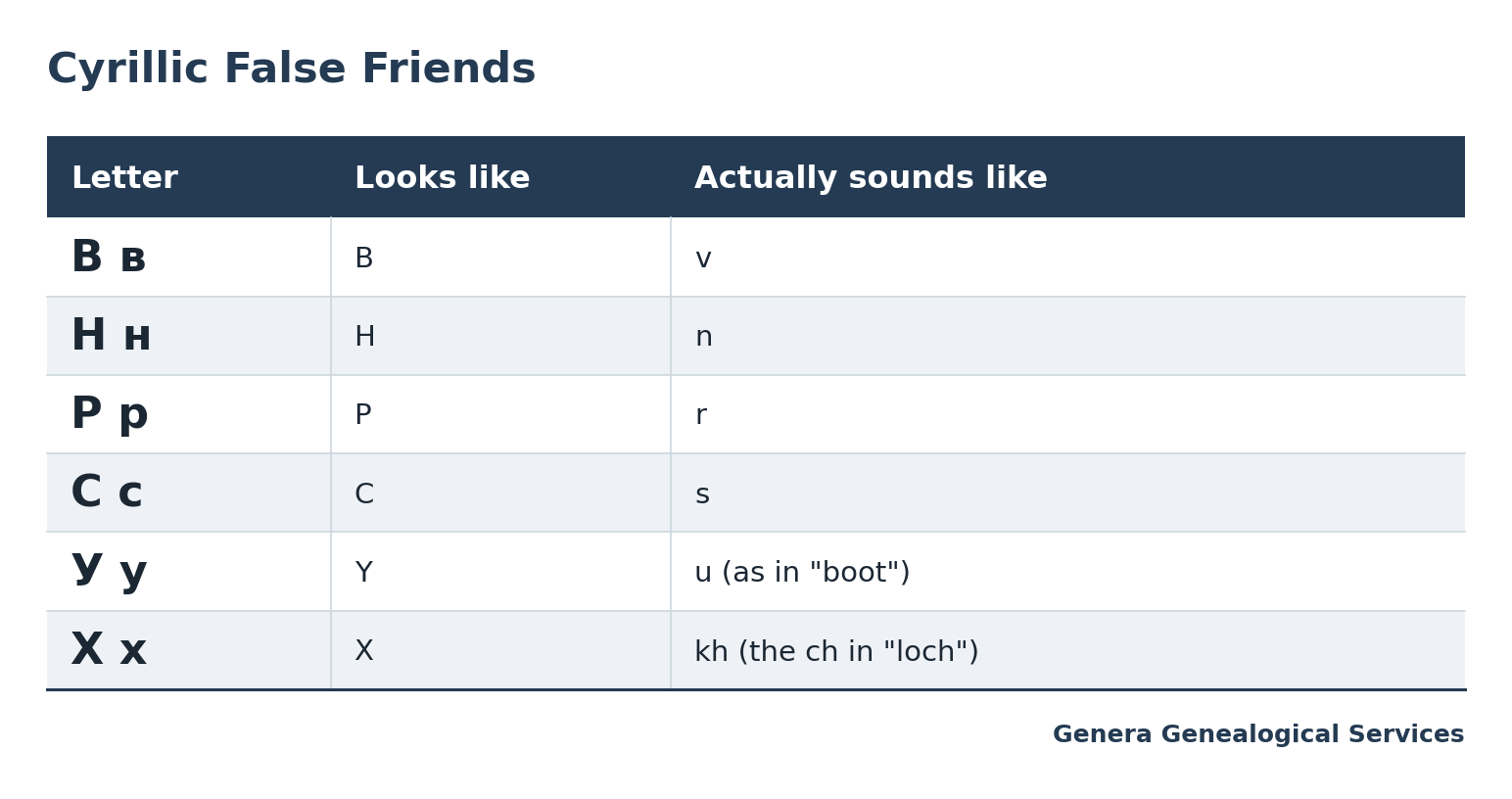
The false friends cause the most trouble, because they look like familiar Latin letters and stand for something completely different. These six cause more first-day misreadings than anything else on the page:
Letter Looks like Actually sounds like В в B v Н н H n Р р P r С с C s У у Y u (as in “boot”) Х х X kh (the ch in “loch”)
Read Иванов (Ivanov, “ee-va-NOF”) with that table in hand: the Н is an n and the В is a v, so the name is Ivanov, not “Ihanob.”
The new shapes have no Latin lookalike and must simply be memorized. They are fewer than they first appear: Б (b), Г (g), Д (d), Ж (zh, as in the s of “measure”), З (z), И (ee), Й (a short y, marked by a small curved breve above the letter), Л (l), П (p), Ф (f), Ц (ts), Ч (ch), Ш (sh), Щ (shch), Э (a plain eh), Ю (yu), and Я (ya). Two more are signs rather than sounds: the hard sign Ъ and the soft sign Ь, which modify the consonant before them. One vowel, Ы, is a back, hard ih with no real English equivalent; you will learn it by ear from the words it sits in.

That is the whole working set. Print a chart that shows each letter in both its printed and cursive forms and keep it beside you. The first session is spent looking letters up; by the third record you will usually be looking up only the awkward ones.
First Clues for Telling the Languages Apart
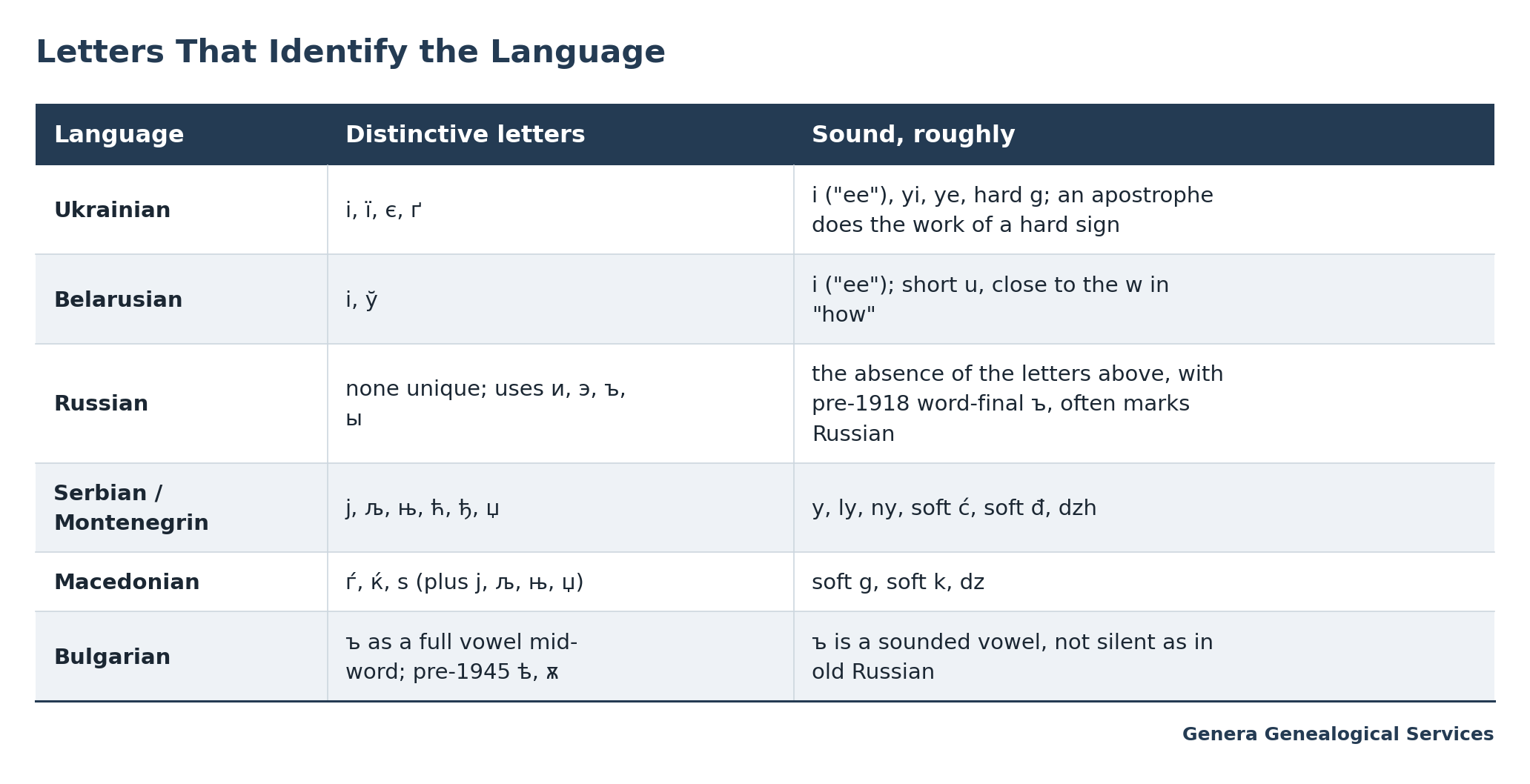
Once you can read the letters, the next skill is telling which Slavic language you are looking at, because the alphabet is not identical across them. The fastest way to confirm a language is to look for the letters that one language has and its neighbors lack.
Language Distinctive letters Sound, roughly Ukrainian і, ї, є, ґ i (”ee”), yi, ye, hard g; an apostrophe does the work of a hard sign Belarusian і, ў i (”ee”); short u, close to the w in “how” Russian none unique; uses и, э, ъ, ы the absence of the letters above, with pre-1918 word-final ъ, often marks Russian Serbian / Montenegrin ј, љ, њ, ћ, ђ, џ y, ly, ny, soft ć, soft đ, dzh Macedonian ѓ, ќ, ѕ (plus ј, љ, њ, џ) soft g, soft k, dz Bulgarian ъ as a full vowel mid-word; pre-1945 ѣ, ѫ ъ is a sounded vowel, not silent as in old Russian
A single distinctive letter is often enough. A ў is a strong sign of Belarusian. A ґ or є means Ukrainian. The ј family means Serbian, Montenegrin, or Macedonian, and the ѓ ќ ѕ set narrows that to Macedonian. The regional sections near the end of this article give the beginner-level differences.
Civil Script and Liturgical Church Slavonic
Settle which of two kinds of writing you are looking at, because they share most of their letters while remaining distinct.
The first is the civil script, the гражданский шрифт (grazhdanskii shrift, “grazh-DAN-skiy shrift”), the rounded, Western-looking typeface and written hand introduced under Peter the Great beginning in 1708, when he cut the old alphabet down and reshaped its letters to resemble Latin type. This is the writing behind nearly every civil register, tax list, school record, and most of the parish books you will handle from the eighteenth century forward. The alphabet you just learned belongs to this civil-script tradition.
The second is older and liturgical. Church Slavonic, the церковнославянский (tserkovnoslavianskii, “tser-kov-no-sla-VYAN-skiy”), kept an earlier and heavier hand with extra letters the civil script discarded, with stacked abbreviation marks called the титло (titlo, “TI-tlo”) that compress sacred words into a few strokes, and with numbers written as letters rather than digits. In that older system, selected letters carry numerical values and are marked with a titlo above them, so a date may appear as a short string of titlo-topped letters rather than as figures. You will meet Church Slavonic in older Orthodox and Greek Catholic registers and in material written by a hand trained for the altar. The visual cues are reliable: titlo marks above words, letter-numbers in place of figures, dense ligatures binding two or three letters together, and ornamental religious headings. Ordinary family research rarely requires full mastery of Church Slavonic, but it does require recognizing its visual system well enough not to mistake a liturgical heading for ordinary civil text, so that you slow down when you have crossed into it.
The Letters That Were Dropped
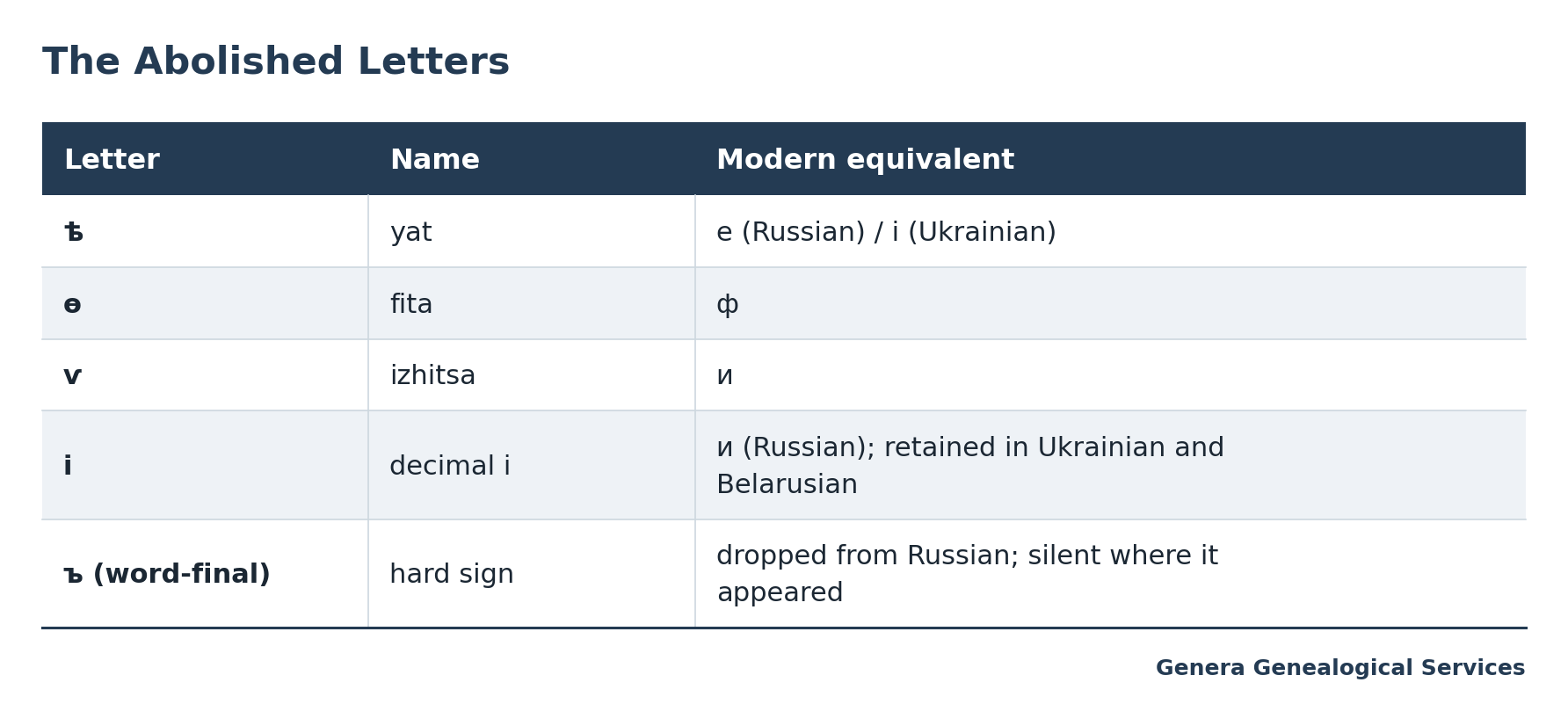
Penmanship is rarely what makes an older page look illegible. More often the cause is a small group of letters that were in daily use across the older records and were then abolished or altered, so that a reader who learned the alphabet from a modern chart does not recognize them.
Four are worth memorizing before anything else.
ѣ, the letter yat (pronounced “yaht”), looks like a soft sign topped by a small crossbar. It stood for a vowel that had already shifted in the spoken language, and its modern replacement depends on which language you are reading: in Russian it usually corresponds to е, while in Ukrainian it often corresponds to і. It turns up constantly in word endings and common names, and it was the most frequent of the abolished letters.
ѳ, fita (pronounced “FEE-ta”), is a circle crossed through the middle. It carried an f sound in names of Greek origin, so a Theodore or a Thekla will not look the way you expect.
ѵ, izhitsa (pronounced “ee-ZHEE-tsa”), is rare and survives mostly in a handful of church words, where it usually stands for an i sound.
і, the decimal i, is a single dotted stroke that lived alongside ordinary и in pre-reform Russian. Its use was governed mostly by spelling convention rather than by a separate sound. It remains in everyday use in modern Ukrainian and Belarusian.
To these add the hard sign ъ, the твёрдый знак (tvyordyi znak, “TVYOR-dyy znak”), which in pre-reform Russian was written at the end of an enormous number of words and carried no sound at all. A surname you already recognize may appear with a silent extra letter at its end.
These letters were not all abolished at the same time or in the same place, and several were never abolished at all, only used differently from one language to the next. The Russian reform of 1918 removed ѣ, ѳ, ѵ, і, and the word-final ъ from Russian spelling. Bulgaria removed ѣ and the big yus ѫ in 1945, while keeping ъ in the middle of words, where it denotes a real vowel. Ukrainian and Belarusian dropped the yat in earlier decades while keeping the decimal і. Serbian had largely abandoned the yat by the mid-nineteenth century under Vuk Karadžić’s reform. Knowing which language a document is in tells you which older letters to expect.
Letter Name Modern equivalent ѣ yat е (Russian) / і (Ukrainian) ѳ fita ф ѵ izhitsa и і decimal i и (Russian); retained in Ukrainian and Belarusian ъ (word-final) hard sign dropped from Russian; silent where it appeared.
Why the Cursive Is the Hard Part
Printed Cyrillic is the easy half. The handwriting is the demanding part, because the running hand, the скоропись (skoropis’, “SKO-ro-pis”), departs from the printed forms far more drastically than Latin cursive departs from Latin print.
The chief obstacle is a group of letters that all collapse, in a hurried hand, into a row of nearly identical humps. The letters и, ш, т, п, л, and м each become a sequence of up-and-down strokes, so a single word can become a row of nearly identical vertical strokes with little to mark where one letter ends and the next begins. Some clerks drew a small bar above the т or a tail under the ш to keep them apart, and training your eye to look for those marks does much of the work. The letters и and й differ only by a small breve that a fast pen or a faded scan can lose. Capital letters tend to be elaborate and personal, and one clerk will form the same capital a dozen slightly different ways across a single volume.
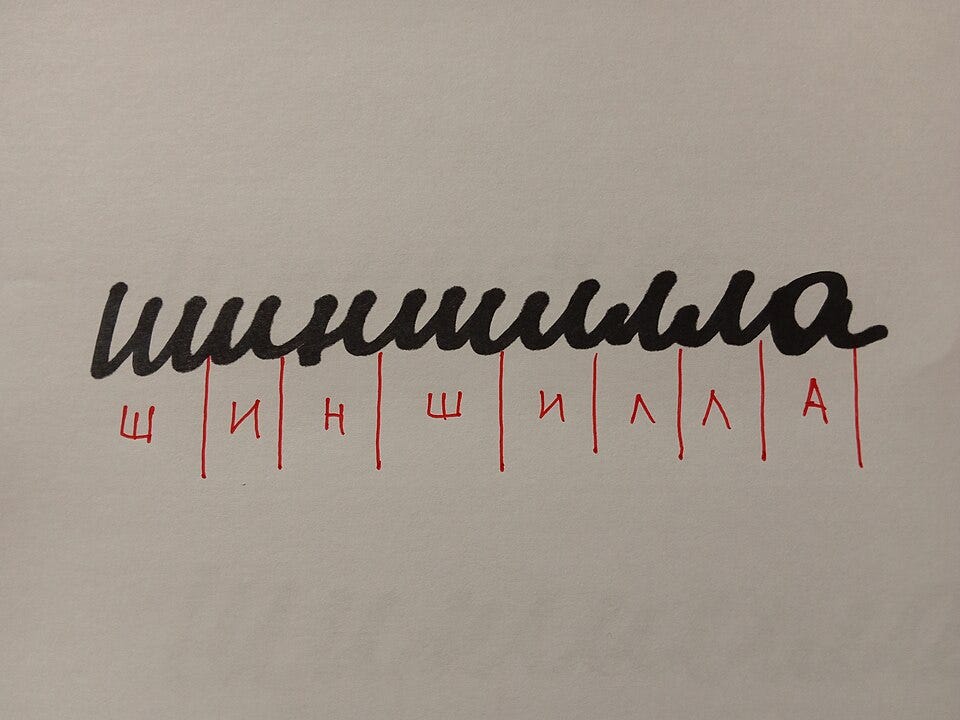
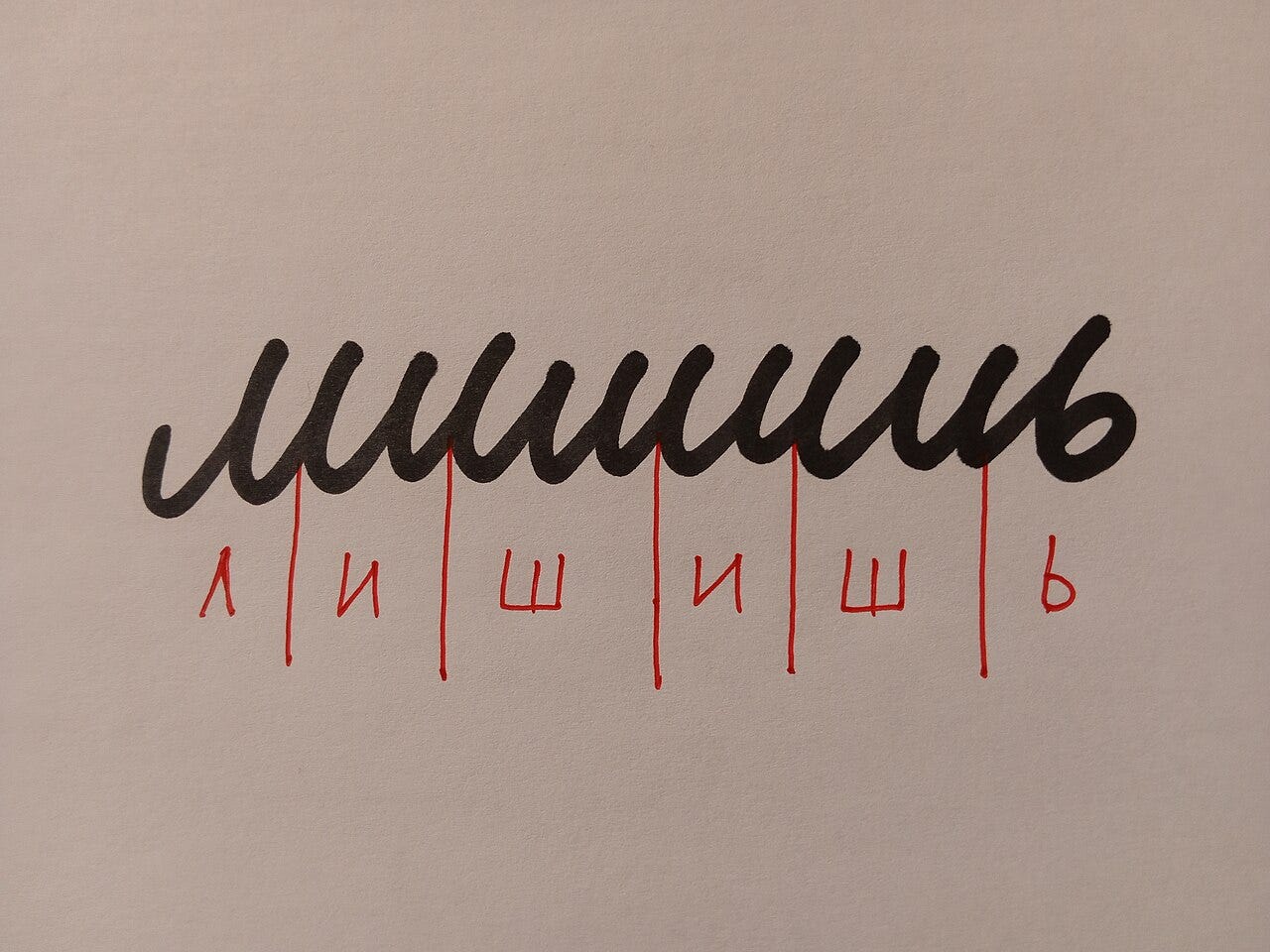
The method here is the one any paleographer uses. Find a word on the page you already know, such as a place name from the parish heading, a saint’s name, or the word for the event, and use it to work out how this particular clerk forms his letters. Once you have seen how he writes his в and his д inside a word you can identify, you can carry that knowledge to the words you cannot, and the records usually supply such known words readily.
A First-Page Method
When a new page is in front of you, work in this order before trying to read it word for word.
First, identify who created the record: an Orthodox parish, a Greek Catholic parish, a Roman Catholic parish, a synagogue, a civil registrar, a military office, a tax office, or a court. The creator usually explains the language and script before you have read a word.
Next, identify the record type from its shape, whether a register of repeating dated entries, a household list, or a tax roll.
Identify the language from its distinctive letters and month names. Locate the date, then the principal name (the child, the spouse, or the deceased), and then the parents. Mark any word you cannot read and move past it instead of stalling.
Then compare the next entry, which will repeat most of the same words in the same places and will teach you the clerk’s hand as you go.
That sequence works because the records were built to be filled in the same way every time, so what you are reading is a standard form whose contents you can anticipate before you have deciphered them.
What You’ll Be Reading
A short orientation, since the worked example below comes from a parish register. Much of the genealogy in the Russian imperial and East Slavic Cyrillic world sits in three record types: the metrical book (the parish register of births and baptisms, marriages, and deaths), the revision lists (the empire’s periodic tax census of households), and the confession lists (annual records of who came to confession and communion). Each is ruled into predictable columns, which is exactly why you can read them without fluency. The later pieces in this series treat each record type in depth; for now it is enough to know that the page in front of you is almost certainly one of these three, filled in the same way every clerk in the district filled it.
Reading the Names
A few features of the names themselves carry more weight than beginners expect. Recognizing these features is part of reading the script.
The first is the patronymic, a middle name formed from the father’s given name. The convention is strongest in the East Slavic languages, where it appears as the по батькові (po bat’kovi, “po BAT-ko-vi”) in Ukrainian and the отчество (otchestvo, “OT-chest-vo”) in Russian. A man recorded as Petr Ivanovich (Russian) or Petro Ivanovych (Ukrainian) is Peter, son of Ivan; a woman recorded as Марія Іванівна (Mariia Ivanivna, “ma-REE-ya ee-VA-niv-na”, Ukrainian feminine -івна) or Марья Ивановна (Mar’ya Ivanovna, “MAR-ya ee-VA-nov-na”, Russian feminine -овна / -евна) is Maria, daughter of Ivan. Either entry gives you the father’s name directly, identifying the previous generation in a single line. The feminine forms are worth learning, because death and confession entries are often the only place a woman is named at all. South Slavic naming works differently. Bulgarian uses a patronymic in the middle position, while Serbian, Montenegrin, and Macedonian rely instead on surname endings (-ić, -ev, -ov, -ski) that once meant “of” or “son of” and have become hereditary.
The second is the gap between the baptismal name and the everyday name, which is wider in Slavic Orthodox records than most newcomers expect. The clerk used the canonical, often Greek-rooted form of the saint’s name, while the household used a vernacular variant that can appear as a different name entirely. The Іоаннъ (Ioann, “ee-o-AHN”) of the baptismal entry is the same man known as Иван (Ivan, “ee-VAHN”) for life. Георгий (Georgii, “ge-OR-gi”) may appear as Юрий (Yurii, “YU-ri”) in Ukrainian-speaking contexts and Егор (Yegor, “ye-GOR”) in Russian ones. Иосиф (Iosif, “i-O-sif”) may be Осип (Osip, “O-sip”). Феодоръ (Feodor, “fe-O-dor”), written with the fita you just learned, is the Фёдор (Fyodor, “FYO-dor”) you might already recognize. Among women, Параскева (Paraskeva, “pa-ras-KE-va”) appears in life as Прасковья (Praskov’ya, “pras-KOV-ya”) and Феодосия (Feodosia, “fe-o-DO-sia”) as Федосья (Fedos’ya, “fe-DOS-ya”). A descendant who knows grandfather as Yegor and finds no Yegor in the register has simply not yet learned to look under Georgii. Keep a short list of these equivalents handy until the pairs become automatic.
The third is that surnames inflect for gender across most of the Slavic languages, so a wife and a daughter appear under a form of the family name that differs from the father’s. The Russian and Ukrainian surnames in -ов, -ев, -ин take feminine endings in -ова, -ева, -ина; those in -ський / -цький take -ська / -цька. A father listed as Иванов (Ivanov, “ee-va-NOF”) has daughters listed as Иванова (Ivanova, “ee-va-NO-va”), and they are the same family. The Ukrainian endings in -енко and most foreign-rooted names do not decline, which is why the worked example shows an Anna Kovalenko whose surname matches her father’s letter for letter.
The last hazard is romanization. A single Cyrillic name takes several Latin spellings depending on the system in use, so the Russian Юрий (Yurii) appears in catalogs as Yuri, Yury, Yuriy, or Iurii, and a search that tries only one will miss the others. Settle on one transliteration standard and apply it consistently. ALA-LC is the usual scholarly choice, though a consistent personal system works fine for working notes. Keep the original Cyrillic spelling beside it, since the Latin form is lossy and the Cyrillic is what allows you to verify the name against the original record.
Dates and Month Names
Two things about dates matter while you are still learning to read the page.
The first concerns the Julian calendar. Much of the Orthodox Slavic world used Old Style dating in its records until the early twentieth century, running roughly twelve to thirteen days behind the Western Gregorian calendar. Record the date exactly as it stands, mark it Old Style, and carry a converted date beside it without overwriting the original. Calendar practice also changed at the imperial border, so a line that crosses from Austrian Galicia, on the Gregorian calendar, into Russian-Empire territory, on the Julian, moves between two systems within a single pedigree. The mechanics of conversion, and the way church and civil calendars diverged, get their own treatment later in the series.
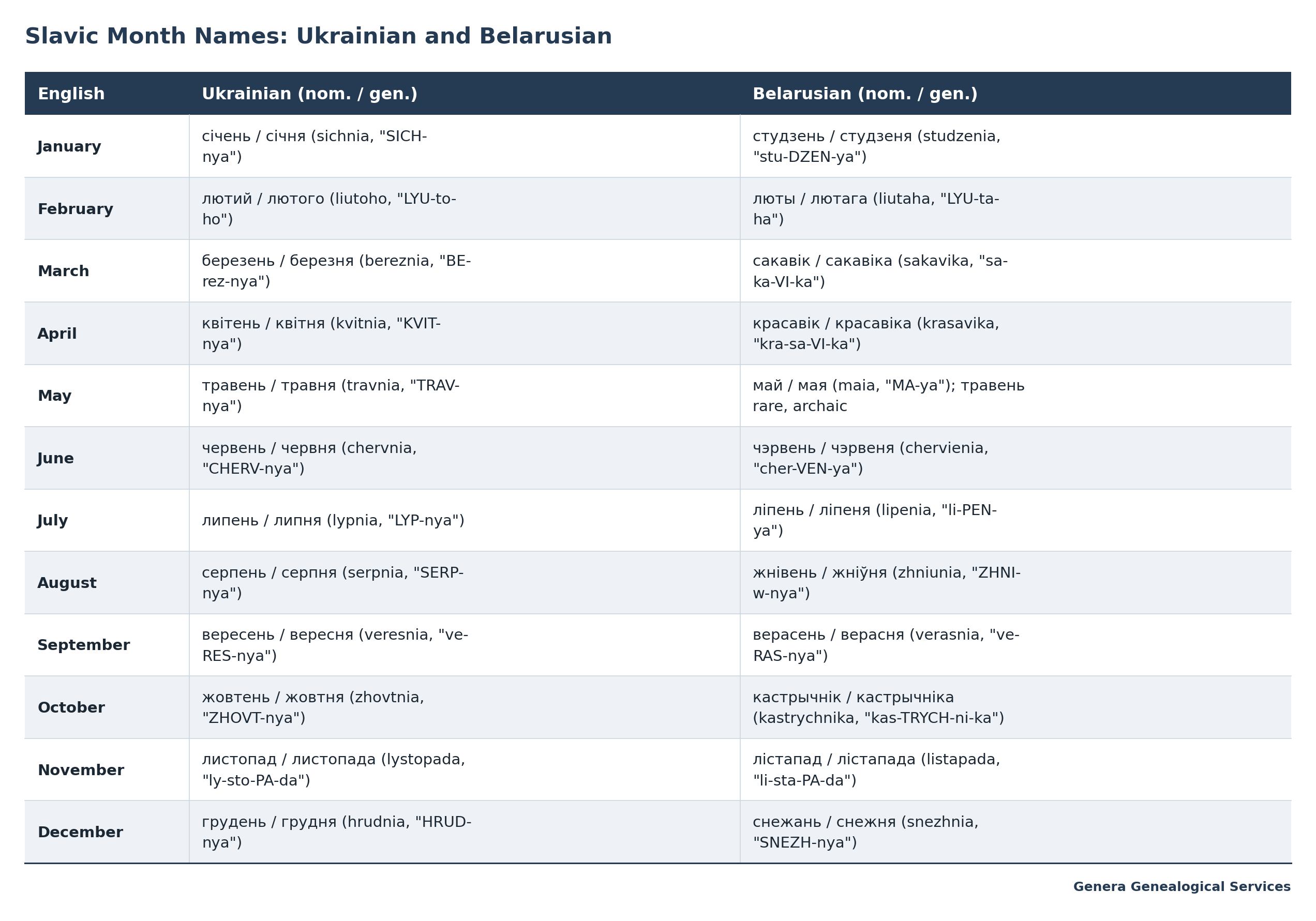
The second concerns the month names. The Ukrainian, Belarusian, and Rusyn month names are old Slavic words that look nothing like the Latin-derived sets used in Russian and the South Slavic languages. In records, months usually appear in the genitive (”of January”), which swaps the final letter or two. The table gives the nominative first, then the genitive form that actually appears in dated entries, with a rough pronunciation of the genitive.
The Russian months are the internationally familiar set, easiest to recognize once transliterated: январь (yanvar’, “yan-VAR”), февраль (fevral’, “fev-RAL”), март (mart, “MART”), апрель (aprel’, “ap-REL”), май (mai, “MAY”), июнь (iyun’, “i-YUN”), июль (iyul’, “i-YUL”), август (avgust, “AV-gust”), сентябрь (sentyabr’, “sen-TYABR”), октябрь (oktyabr’, “ok-TYABR”), ноябрь (noyabr’, “no-YABR”), декабрь (dekabr’, “de-KABR”). The Bulgarian, Serbian, Montenegrin, and Macedonian months follow the same Latin-derived pattern with small spelling variations. All of them also appear in case-marked forms in records (января, февраля, марта for “of January, February, March”), but they resemble the international names closely enough to recognize. Years were often written out as words rather than figures, so learn the building blocks: тысяча (tysyacha, “TY-sya-cha”, “thousand”), сто (sto, “STO”, “hundred”), the units one through twenty, and the round hundreds, and you can read any year on the page.
A Working Vocabulary
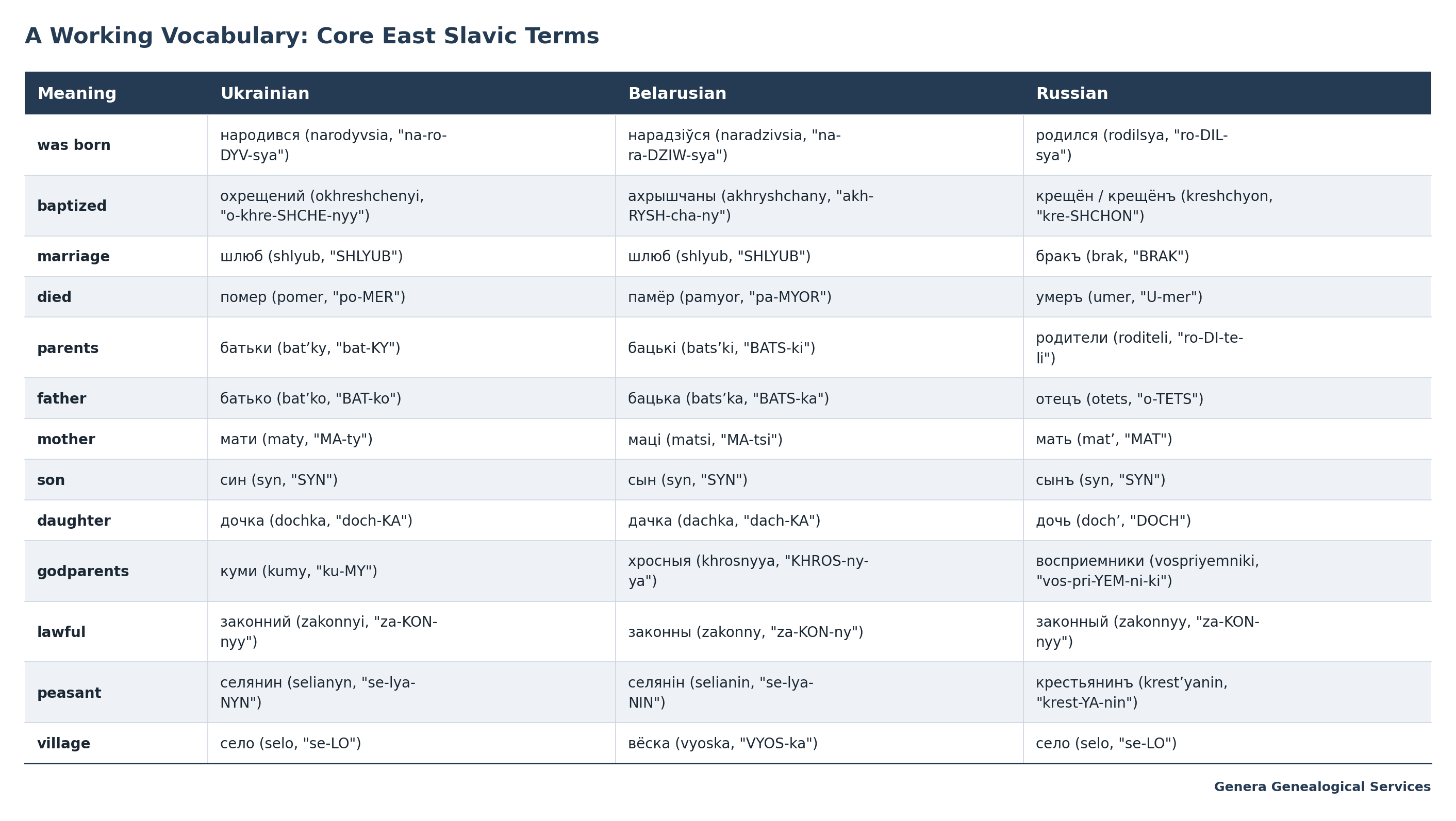
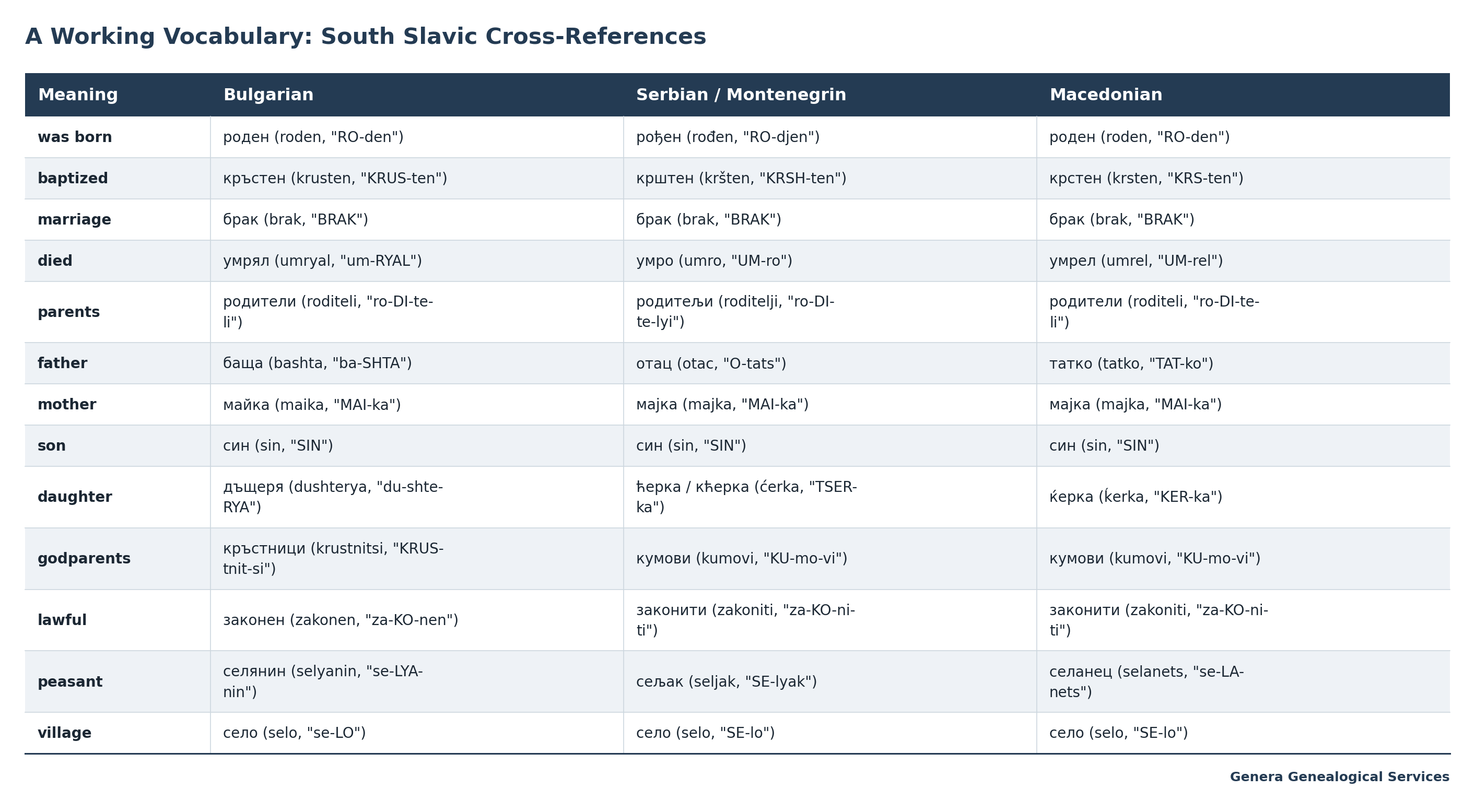
You can lift almost everything genealogical out of these records with a small vocabulary, and the words recur so often that you will know them within a few entries. The forms are given in Cyrillic with a transliteration and a rough pronunciation. The Russian column shows the common forms found in records, with pre-reform spellings (the final hard signs) marked where they would have appeared in nineteenth-century usage.
Core East Slavic Terms
South Slavic Cross-References
The Regional Scripts
The sections that follow are brief orientations. Each names the distinctive letters that identify the language and the one or two things about its script that most often trip up a beginner reading that tradition.
Russian
Russian sits at the center, because the alphabet you learned above is the modern Russian alphabet, and the system established by Peter the Great shaped record-keeping across the territories the empire held. Russian has no unique modern letters. You identify it by the absence of the distinctive Ukrainian, Belarusian, and Serbian letters, and, in pre-1918 material, by the silent word-final ъ attached to so many words. Pre-reform Russian also carries the dropped letters above (yat, fita, izhitsa, and decimal i), so an older Russian page can look unfamiliar until you recognize those few signs.
One point matters even for non-Russian families: civil and parish records were kept in imperial Russian regardless of the family’s mother tongue or confession. In Congress Poland (the Kingdom of Poland under Russian rule), civil-status records were kept in Polish until 1868, when Russian became mandatory and remained so until the end of Russian rule during the First World War. Polish Catholic and Polish-Jewish vital records appear in Cyrillic Russian throughout that half-century. Reading Russian script, in other words, does not mean the family was Russian.
Ukrainian
The Ukrainian alphabet carries letters the others lack: the dotted і (”ee”), the ї (”yee”), the є (”yeh”), and the hard ґ, while an apostrophe does the separating work that a hard sign does elsewhere. Spotting any of these confirms a Ukrainian-language record at a glance. The yat, where older spelling shows it, generally corresponds to і.
The harder lesson is geographic, because the language of the record follows the border rather than the family. In Galicia and Bukovina, under Austrian rule, Greek Catholic and Roman Catholic registers were kept variously in Latin, Polish, German, Romanian, and Church Slavonic, sometimes shifting language inside a single entry. In the central and eastern regions under the Russian Empire, Orthodox parish books were kept in imperial Russian whatever the family spoke at home. The place names create a related difficulty: one village might appear as Львів (Lviv, “L-VEEV”) in Ukrainian, Lwów in Polish, Lemberg in German, and Львовъ (L’vov, “L-VOV”) in Russian. Learn the alternative names for your village before you search.
Belarusian
The Belarusian alphabet shares the dotted і with Ukrainian and adds its own distinctive ў (a short u, close to the w in “how,” often called the non-syllabic u), which is a reliable sign that you are reading Belarusian. The same family may pass through Greek Catholic, Orthodox, Polish-language, Latin-script, and Russian imperial records depending on the period, so one lineage can run through more than one language and more than one script. The reading skills stay the same; what changes is the readiness to identify which tradition produced the page. Belarusian place names carry the same multilingual layering: Вільня (Vilnia, “VIL-nya”), Vilnius in Lithuanian, Вильна (Vil’na, “VIL-na”) in Russian Imperial spelling, and Wilno in Polish all refer to the same city.
Rusyn
Rusyn records are usually not hard because of Cyrillic itself. They are hard because the family may appear in Latin, Hungarian, Church Slavonic, Ukrainian-like Cyrillic, Polish, Slovak, or Serbian contexts depending on place and date. The Carpatho-Rusyn homeland straddles what is now western Ukraine, eastern Slovakia, southeastern Poland, and northern Serbia. The dominant tradition is Greek Catholic, with smaller Orthodox communities, and personal names appear sometimes in Cyrillic and sometimes in Latinized form. A reader who can handle Ukrainian church-language records will recognize most Rusyn Cyrillic on sight, while remembering that the surrounding administrative records are likely in Hungarian, Latin, Polish, or Slovak.
Bulgarian
The Bulgarian alphabet gives a letter you already know a different job. The hard sign ъ, silent at the end of pre-1918 Russian words, is a full, sounded vowel in Bulgarian and stays in the middle of words in modern spelling. The same letter does very different work in the two languages, which catches researchers who learned one orthography and carried its habits into the other. Bulgarian’s own 1945 reform removed the yat ѣ and the big yus ѫ; the big yus survived in Bulgarian spelling longer than in most other Cyrillic traditions, and a pre-1945 word that used it often appears as ъ or а in modern spelling. Before the 1870s, many church records are in Greek rather than Bulgarian Cyrillic, so a family traced across that line may cross alphabets. Place names layer too: Пловдив (Plovdiv, “PLOV-div”) was Filibe in Ottoman Turkish and Philippopolis in Greek.
Serbian
Serbian takes its modern form from Vuk Karadžić’s reform, confirmed for state use in 1868, built on a one-letter-one-sound principle. The Cyrillic he established adds several letters found nowhere to the north: ј (a y sound), љ (ly), њ (ny), ћ (a soft palatal stop), ђ (its voiced counterpart), and џ (dzh). Records produced before Vuk’s victory are in Slavonic-Serbian (Slaveno-Serbian), a hybrid of Church Slavonic and vernacular that needs a different reading strategy than the modern alphabet. Modern Serbian also uses Latin script alongside Cyrillic, so the script on the page is not a reliable guide to date by itself. Place names move with the rulers: Нови Сад (Novi Sad, “NO-vi SAD”) was Neusatz under Austria.
Montenegrin
For genealogy, Montenegrin records should be approached as Serbian Cyrillic, or as Serbian-recension Church Slavonic for older liturgical material, until the modern period. The separate modern Montenegrin standard acquired its own alphabet only in 2009 and rarely touches nineteenth- or early twentieth-century family records. A reader who can handle Serbian records can handle Montenegrin ones with no further adjustment.
Macedonian
Macedonian is the youngest of the standardized Slavic Cyrillic languages, codified in 1944, and the timing matters: most records from before 1944 were written in some other language. Late Ottoman material (the empire held the territory until 1912 to 1913) is in Ottoman Turkish or Greek; interwar records are typically in Serbian, with Bulgarian in areas under Bulgarian rule. When you do meet the modern alphabet, it is built on Vuk’s phonemic principles and includes letters seen nowhere else: ѓ (a soft g), ќ (its voiceless counterpart), and ѕ (a dz sound), along with the ј, љ, њ, and џ it shares with Serbian. Establish the period and jurisdiction before deciding what language the page is in. Place names carry the full quartet: Skopje is Скопје (Skopje, “SKOP-ye”) in Macedonian, Скопље (Skoplje, “SKOP-lye”) in Serbian, Скопие (Skopie, “SKOP-i-ye”) in Bulgarian, and Üsküb in Ottoman Turkish.
The Six Alphabets Side by Side
Reading the regional sections one tradition at a time gives you the shape of each. Sometimes what you want instead is the whole picture at once, with every modern Slavic Cyrillic alphabet next to every other so you can see at a glance which letters appear where and what each one sounds like. The letter Г, for example, is a hard g in Russian, Bulgarian, Serbian, and Macedonian, but a softer h in Ukrainian and Belarusian. This is why a name like Григорій (Hryhorii, “hry-HO-ri”) in a Ukrainian register reads aloud closer to “Hryhorii” than to “Grigori.”
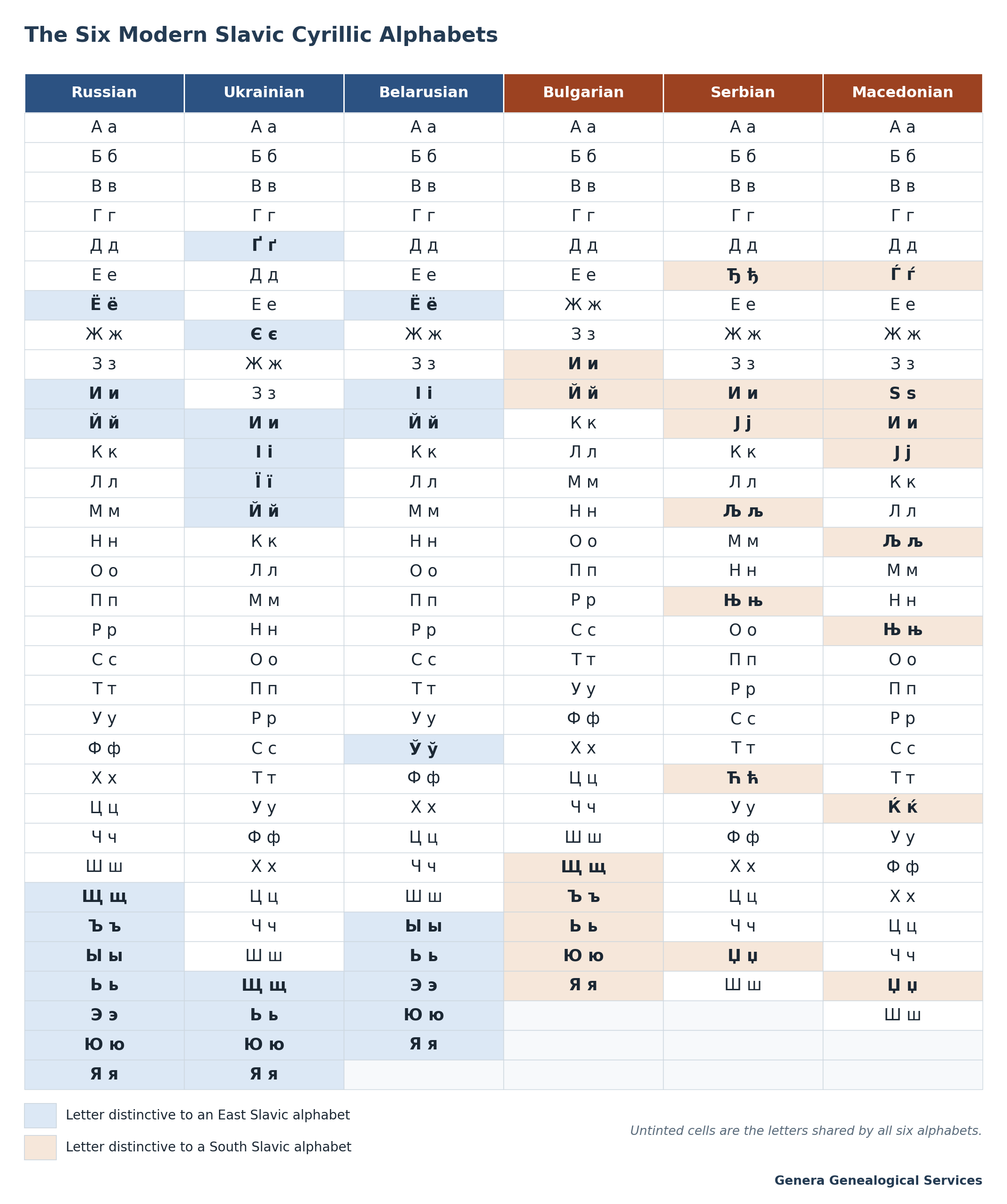
The chart makes several patterns visible at a glance. Serbian and Macedonian carry fewer letters than the East Slavic alphabets because Vuk Karadžić’s nineteenth-century reform stripped out everything redundant, leaving an alphabet of one letter per sound. The same letter shape often does different work across the alphabets. Х is kh in the East Slavic alphabets but a plainer h in the South Slavic transliterations, Щ is shch in Russian and Ukrainian but sht in Bulgarian, and Ъ is a silent hard sign in pre-reform Russian but a sounded vowel in modern Bulgarian. The family groupings also show clearly. Ukrainian and Belarusian share their soft h for Г, their use of І for the “ee” sound, and the avoidance of the hard sign. Serbian and Macedonian share their Ј, Љ, Њ, and Џ. Bulgarian agrees with Russian on most of its core letter set while breaking off on Х, Щ, and Ъ.
Older documents will add letters the chart does not show, because they were abolished or were never part of the modern alphabets at all. The handful most likely to turn up in pre-reform Russian and Ukrainian records, namely yat (ѣ), fita (ѳ), izhitsa (ѵ), decimal i (і), and the silent word-final hard sign, are treated in their own section above. Pre-1945 Bulgarian carries the yat and additionally the big yus (ѫ), which usually corresponds to ъ or а in modern spelling. Church Slavonic carries several more, including iotated forms and ligatures, and a researcher working liturgical material will want the fuller chart Wikipedia maintains at its Cyrillic alphabets and Early Cyrillic alphabet articles. The same Wikipedia entry covers the non-Slavic Cyrillic alphabets, including Mongolian, Tajik, Kazakh, and the dozens of other languages of the former Soviet space, most of which sit outside what Western genealogists typically work in.
Work With Genera Genealogical Services
The unfamiliar Slavic Cyrillic scripts described here are one of the most common points where a capable researcher has to hand a project off, because a line that crosses into Russian, Ukrainian, Belarusian, Rusyn, or Balkan records asks for skills that sit outside most practices. Genera Genealogical Services takes that work on directly, whether as a subcontracted research block on a single difficult line or as a full referral, and if you read these scripts yourself, collaboration is equally welcome.
Genera Genealogical Services conducts documented, source-cited research in line with the Genealogical Proof Standard, with primary-source work in English, Russian, French, German, Ukrainian, Church Slavonic, and Latin across American, Eastern European, and multilingual archival sources. Projects are billed in five-hour blocks at $75 per hour, $375 per block. To discuss a family line, a difficult research problem, or a professional collaboration, write to generagenealogicalservices@gmail.com.
Sources
Comrie, B., Stone, G., & Polinsky, M. (1996). The Russian language in the twentieth century (2nd ed.). Clarendon Press.
Cubberley, P. (1996). The Slavic alphabets. In P. T. Daniels & W. Bright (Eds.), The world’s writing systems (pp. 346 to 355). Oxford University Press.
Friedman, V. A. (2002). Macedonian. SEELRC reference grammar. Duke University.
Greenberg, R. D. (2004). Language and identity in the Balkans: Serbo-Croatian and its disintegration. Oxford University Press.
FamilySearch. (n.d.). Russia handwriting. FamilySearch Research Wiki. Retrieved June 1, 2026, from https://www.familysearch.org/en/wiki/Russia_Handwriting
FamilySearch. (n.d.). Russia church records. FamilySearch Research Wiki. Retrieved June 1, 2026, from https://www.familysearch.org/en/wiki/Russia_Church_Records
FamilySearch. (n.d.). Serbia beginning research. FamilySearch Research Wiki. Retrieved June 1, 2026, from https://www.familysearch.org/en/wiki/Serbia_Beginning_Research
Magocsi, P. R. (2015). With their backs to the mountains: A history of Carpathian Rus’ and Carpatho-Rusyns. Central European University Press.
Pihach, J. D. (2007). Ukrainian genealogy: A beginner’s guide. Canadian Institute of Ukrainian Studies Press.
Shea, J. D., & Hoffman, W. F. (2000 to 2002). In their words: A genealogist’s translation guide to Polish, German, Latin, and Russian documents (Vols. 1 to 2). Language & Lineage Press.
Society for German Genealogy in Eastern Europe. (n.d.). Translating Russian documents from Poland. Retrieved June 1, 2026, from https://www.sggee.org/research/rus_translate/general_intro.html