Deciphering Old German Script In Genealogy
A Beginners' Guide

If you have German-speaking ancestry and you have been tracing your family back through the centuries, at some point you are going to open a digitized church register or civil record and find yourself staring at handwriting that looks like it belongs to an entirely different writing system. The letters will not match anything you learned in school, and if you are like most researchers encountering this for the first time, your first instinct will be to close the image and move on to a different record.
The encouraging reality is that you do not need to master Kurrent in the way you would master a foreign language. Genealogical records are formulaic by nature, built from the same small set of words repeated across thousands of entries in the same formats. A baptismal register from 1780 in Württemberg uses essentially the same vocabulary and column structure as one from 1830 in Saxony. Once you can recognize the forty or fifty most common terms and learn to navigate the handful of letters that cause the most confusion, you can pull names, dates, occupations, and family relationships from the vast majority of German-language records you will encounter.
That handwriting is often Kurrent, the dominant German cursive tradition that was in everyday use across the German-speaking world from roughly the 1500s through the early 1900s. Church registers, civil records, personal letters, legal documents, military rolls, and guild records were commonly written in it. Understanding this script is not optional for serious German-language genealogy. Much of the handwritten material before the mid-twentieth century is written in Kurrent, Sütterlin, or a related German script, and the overwhelming majority of those records have never been translated or transcribed into modern letterforms.
This article will walk you through the three scripts you need to recognize, the specific letters and numerals that cause the most difficulty, and the practical strategies for working through documents that feel impenetrable. A companion GGS reference sheet covers the core vocabulary, abbreviations, month names, and occupation terms you will need when working through actual records. For visual reference, you will want an alphabet chart open beside you as you read.
The Family Tree Magazine Germanic Alphabet Chart (free at familytreemagazine.com) shows Kurrent, Sütterlin, and Fraktur letterforms side by side, and the FamilySearch Wiki page on Germany Handwriting (familysearch.org/en/wiki/Germany_Handwriting) provides additional charts and examples. The descriptions below will make far more sense with those references in front of you.
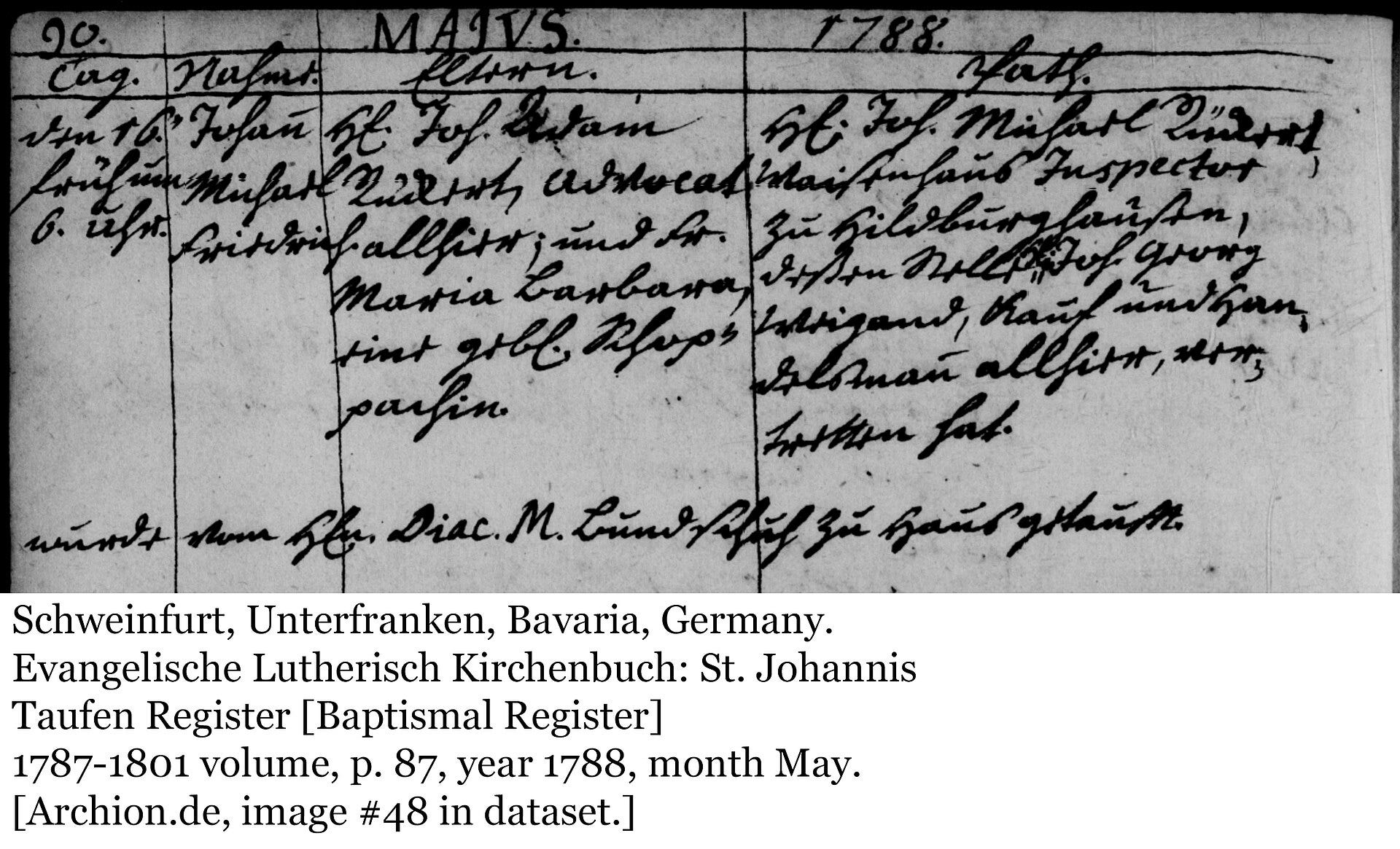
This is the 1788 baptismal register entry for Johann Michael Friedrich Rückert, Schweinfurt. A typical church register page showing Kurrent handwriting with Fraktur column headers.
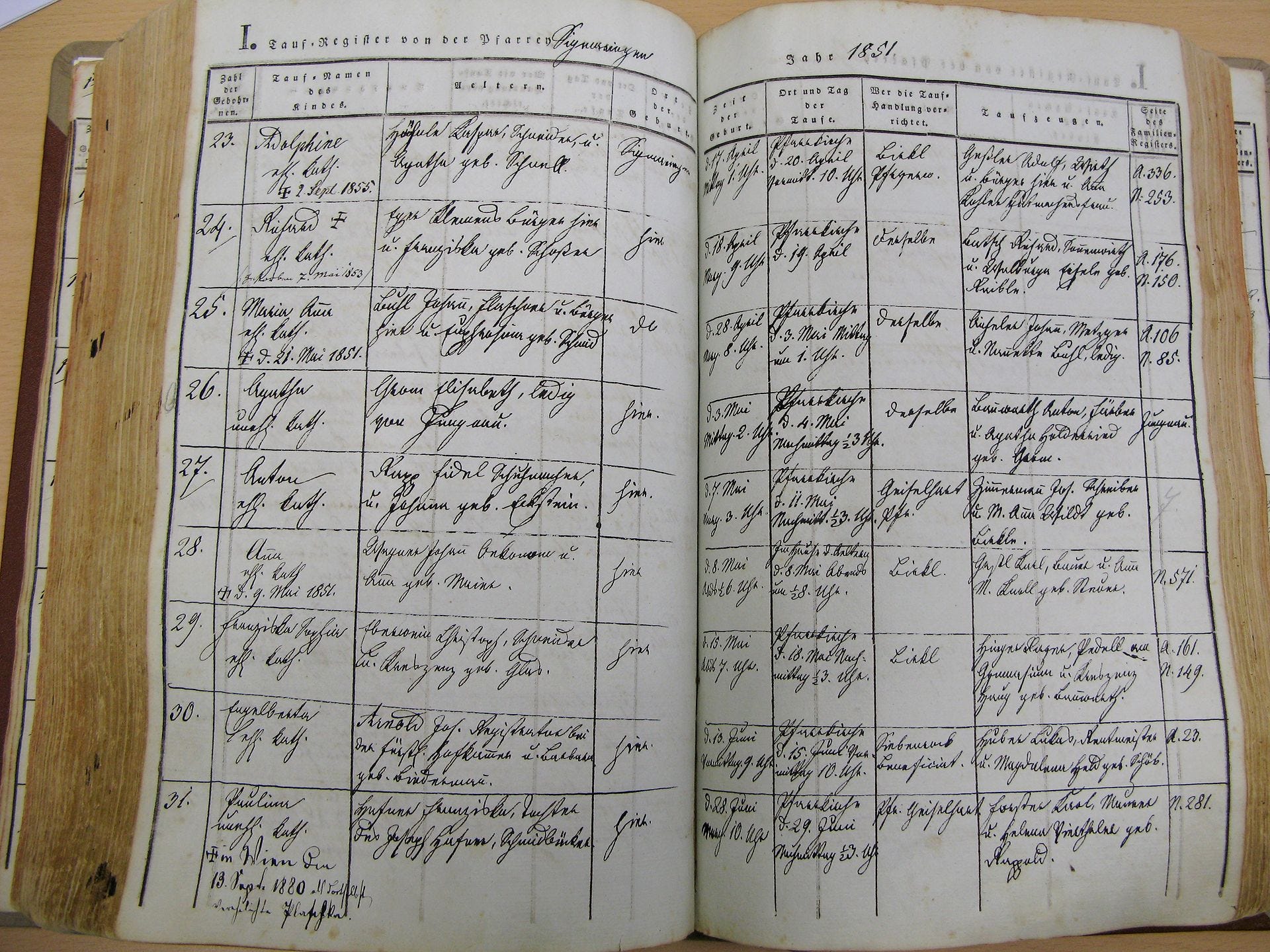
In this image from the baptismal register (Tauf-Register) of the parish of Sigmaringen, 1851, showing Kurrent handwriting entries beneath pre-printed Fraktur column headers.
The Three Scripts in German Records
There are three forms you need to recognize in German genealogical records: Kurrent and Sütterlin as handwriting styles, and Fraktur as printed type. Knowing which one you are dealing with matters because each presents different challenges.
Kurrent Script
Kurrent is the oldest, the most widespread, and the one that causes the most difficulty. It was the everyday cursive handwriting of the German-speaking world for roughly four centuries. You will find it in church books (Kirchenbücher), civil registers, and official documents created before the twentieth century, and in some hands well into the twentieth. The letters are angular, narrow, and slanted forward, with sharp points where modern cursive would have rounded loops. Many Kurrent letterforms bear no visible resemblance to their Latin equivalents, which is why the script looks like a foreign alphabet to untrained eyes even when the underlying language is German.

Kurrent varied by region, period, and individual scribe far more than most beginners expect. A pastor writing in Bavaria in the 1750s produced noticeably different letterforms from a civil registrar in Hamburg in the 1850s, and both differ from a schoolteacher in Bohemia writing in the 1780s. Southern German and Austrian hands tend toward rounder, more flowing forms, while northern German hands are often narrower and more angular. These regional tendencies were never codified into distinct scripts, so the variation is a spectrum rather than a set of clear categories, but it means that a reference chart built from one scribe’s handwriting will not perfectly match the handwriting in every document you encounter. The underlying letter logic is the same across regions; the execution differs.
Sütterlin Script
Sütterlin is a simplified and more standardized descendant of Kurrent, developed by the Berlin graphic artist Ludwig Sütterlin around 1911 and introduced in Prussian schools in 1915. In 1935 a slightly modified version with a forward slant was mandated across all of Germany as the “Deutsche Volksschrift” (German national script); the practical differences from the 1915 version are minor enough that they will not affect your ability to read the records. Compared to Kurrent, Sütterlin is more upright and more uniformly rounded, with vertical strokes written at a consistent angle rather than the steep forward slant of older Kurrent hands. You will encounter Sütterlin primarily in twentieth-century civil records, personal correspondence, and family papers. When you find a family Bible inscription, a letter from a grandparent, or a civil marriage record from the interwar period, the handwriting is very likely Sütterlin.

Fraktur Script
Fraktur is a printed typeface rather than a handwriting style, the “Gothic” block lettering used in German books, newspapers, official forms, and the pre-printed column headings on church registers. You need to recognize Fraktur because it appears on the very documents you are trying to read. The pre-printed headers that label columns as “Taufe” (baptism) or “Pathen” (godparents) are set in Fraktur type while the handwritten entries beneath them are in Kurrent. Fraktur is substantially easier to learn than Kurrent because it is standardized print rather than variable handwriting, but it has its own confusing letter pairs. Among the uppercase letters, S can be mistaken for C, E, or G, and V and B look nearly identical in many typefaces. In lowercase Fraktur, the letter k is frequently mistaken for t by modern readers. The long s and f distinction that causes difficulty in Kurrent handwriting also applies in Fraktur print: both letters have a tall vertical stroke, but the crossbar on f passes through both sides of the stem, while the crossbar on the long s extends only to the left of the stem, leaving the right side clean. In practice this difference can be subtle, especially in smaller type sizes, but once you know to look for which side the crossbar occupies, the two letters become distinguishable.
In 1941, German script and Fraktur type were officially abandoned in favor of Latin script and Antiqua type, though the script was so deeply embedded in German-language culture that many older Germans continued writing in Kurrent for the rest of their lives. If you can read Kurrent, Sütterlin will usually come without much additional effort because the underlying letter logic is the same, and Fraktur is a separate but much shorter learning task.

Script Switching Within a Single Document
One of the most disorienting things you will encounter in German records is the practice of switching between Kurrent and Latin script within the same entry, sometimes within the same line. This was not a mistake or an inconsistency. It was standard practice.
German scribes used Kurrent for German-language text and switched to Latin script (the letters you are accustomed to reading) for words of foreign origin, particularly Latin terms, French-origin words, and occasionally place names from non-German-speaking regions. In a baptismal entry, the pastor might write the German portions of the entry in Kurrent and then switch to Latin script for the word “legitimus” or for a French-origin given name like “Charlotte.” In Catholic records that mix German and Latin within a single sentence, the script often shifts to match the language, so you may find the German phrase “wurde getauft” in Kurrent followed immediately by “in nomine Patris” in Latin script, all in the same line of the same entry.
This switching can be confusing at first because it looks like the scribe’s handwriting suddenly became legible in the middle of an otherwise impenetrable line. Once you realize what is happening, the Latin-script portions actually become helpful anchors. You can read those words easily, and their content helps you understand what the surrounding Kurrent text is saying.
The Letters That Cause the Most Confusion
Kurrent is difficult not because every letter is unfamiliar but because several very common letters are built from the same basic stroke and become nearly indistinguishable from one another in actual handwriting. Open an alphabet chart (the FamilySearch Wiki or Family Tree Magazine charts linked above) and follow along with these descriptions; the letter pairs and problems below are far easier to understand when you can see the forms being discussed.
The e/n/m/u problem is the single biggest obstacle for new readers. In Kurrent, all four of these letters are constructed from the same small pointed arch, and the differences between them come down to how many arches appear and how wide or narrow they are. The letter “e” is written as two short strokes. The letter “n” is also two strokes but slightly wider and more angular. The letter “m” is three strokes. The letter “u” looks nearly identical to “n” but is supposed to carry a small curved mark above it called a U-Bogen (a hook, arc, or small wavy line) that distinguishes it from the surrounding letters. In practice, many scribes wrote the U-Bogen so faintly that it is invisible in digitized images, or they did not bother with it at all. The result is that a word like “Bauer” (farmer) can appear on the page as an undifferentiated string of zigzag strokes, and you must rely on context, word position, and your knowledge of common German genealogical vocabulary to figure out what you are reading.
The h/f/long s confusion is the second major stumbling block. Kurrent uses two forms of the letter “s”: the long s, used at the beginning and middle of words or syllables, and the round s, used at the end of words or syllables and as the second letter in a double-s combination. The long s is a tall letter with a descending stroke, and in many hands it is extremely difficult to distinguish from “h” and “f,” which are also tall letters with descending strokes. The critical visual difference is in the loop or crossbar at the top of the letter: “f” has a crossbar that extends to both sides of the vertical stroke, “h” has a loop that closes to the right and then descends, and the long s has a simpler form without a full crossbar. But in hurried writing, all three can collapse into a single ambiguous shape. The round s, by contrast, looks more like a modern cursive “s” and is usually recognizable. If you encounter a tall letter in the middle of a word that you cannot identify, consider that it may be a long s rather than an h or f, and test whether the word makes sense as a German word with “s” in that position.
Uppercase confusion pairs add another layer of difficulty. The uppercase S in Kurrent can be mistaken for C, E, or G. Uppercase V and B are frequently confused with each other. Uppercase N and R share enough visual similarity that a careless or hurried hand can make them interchangeable. Uppercase I and J were often used interchangeably in German writing before the twentieth century, and many scribes made no distinction between them at all. The Eszett (ß) belongs in this category as well: it resembles a capital B in many Kurrent hands, but because it only appears within or at the end of a word, never at the beginning, its position in the word will always tell you which letter you are seeing.
Umlauts and the superscript e are a frequent source of misread names. In Kurrent, the umlauts ä, ö, and ü were not always written with the two dots familiar to modern German. Instead, many scribes wrote a small superscript “e” above the base vowel, a convention that dates back to medieval German writing and persisted in handwritten records well into the nineteenth century. This superscript e can be so small or faintly written that it disappears entirely in digitized images, leading researchers to record “Muller” when the name is actually “Müller,” or “Bohm” when the record says “Böhm.” The same convention is the origin of the “ue,” “oe,” and “ae” spellings still used in modern German when umlauts are unavailable, which is why you see both “Mueller” and “Müller” as variant spellings of the same surname. When you are reading names in Kurrent, always check for a tiny mark or letter floating above the vowel, because a missed umlaut can send you searching for entirely the wrong family.
The macron (a straight line above a letter) is a standard abbreviation indicating that the letter beneath it should be doubled. A macron above “n” means “nn” and a macron above “m” means “mm.” This is easy to miss, and missing it will cause you to misread names. If you see what appears to be the surname “Manal” but there is a small horizontal line above the “n,” the actual name is “Mannal.” Always look for macrons when you are reading names, because surname spellings in church records already varied enough without adding misread abbreviations to the mix.
Reading Kurrent Numbers
Letters are not the only source of confusion in Kurrent records. The numerals used in German handwriting before the twentieth century differ enough from modern forms that they regularly cause errors in dates, ages, and house numbers.
The most common problem is the Kurrent 1, which is written with a long upstroke and a pronounced serif at the top, making it look like a modern 7 to most readers encountering it for the first time. The Kurrent 7, in turn, carries a horizontal crossbar through its vertical stroke to distinguish it from the 1, a convention that persists in continental European handwriting today but is unfamiliar to most English-speaking researchers. If you are reading a date and the year looks wrong, check whether you are reading a 1 as a 7 or vice versa. A birth date that appears to read “1761” may actually be “1767,” or vice versa. If the date appears impossible for the register, treat that as a warning that one of the numerals has probably been misread.
The 5 in many Kurrent hands has a distinctive form that can be confused with other digits depending on the scribe. The 9 features an upper loop that closes fully and then descends, while the 7 has a more open top with the horizontal crossbar already described. In cramped writing, the difference between the closed loop of the 9 and the open stroke of the 7 becomes difficult to see. The 6 can resemble a 0 when the scribe did not close the top of the loop, and the 3 is formed from two loops stacked vertically, which in tight handwriting can look like an 8. These numeral confusions compound quickly when you are reading dates, because a misread digit in a year can shift an event by decades and lead you to search for corroborating records in entirely the wrong time period.
As with letters, the best strategy is to compare numerals across multiple entries on the same page. If you can identify a date you are certain of, whether from a marginal annotation in a different hand, a printed year in a column header, or a date you have already confirmed from another source, use it to calibrate your reading of that scribe’s numerals before attempting to read the entries that are giving you trouble.
Resource for Numerals: https://www.familysearch.org/en/wiki/img_auth.php/2/28/Kurrent_Script_Dates%2C_Numbers%2C_etc.pdf
Naming Conventions That Affect How You Read the Records
German naming practices in the period covered by most church registers follow patterns that directly affect how you read entries and identify individuals.
Married women are typically recorded under their husband’s surname, with their birth surname indicated by the word geborene (abbreviated geb.), meaning “born as” or “née.” An entry might read “Anna Maria Schneider, geb. Weber,” indicating a woman who was born Anna Maria Weber and married a man named Schneider. If you are looking for a woman’s baptismal entry, you need her birth surname, not her married name, and the marriage or death record is where you will find it.
In many regions, children received multiple given names at baptism but were known throughout life by one of them, not necessarily the first. A man baptized as “Johann Friedrich Wilhelm” might appear in every subsequent record as “Friedrich” or “Wilhelm,” with “Johann” serving as a traditional or religious prefix rather than a name anyone actually used. This practice, sometimes called the Rufname convention, means that you cannot assume the first given name in a baptismal entry is the name the person went by.
Patronymic naming conventions survived in some German-speaking regions well into the period of fixed surnames, particularly in parts of northern Germany, Schleswig-Holstein, and East Friesland, where surnames were still being formed from the father’s given name (Hansen, Petersen, Clausen) in the eighteenth century. The suffixes -sohn (son) and -sen (a contracted form of -sohn) appear in surnames throughout these areas and in Scandinavia-influenced regions. Once these patronymics became fixed as hereditary surnames, they remain constant across generations. But if you are researching in these areas before the transition to fixed surnames and a family’s surname appears to change between generations, you may be seeing a patronymic system rather than a recording error.
In earlier registers, particularly those predating the full establishment of hereditary surnames, you will also encounter occupational and locational bynames that function as apparent surnames in individual entries but do not carry forward to the next generation. An entry recording “Hans Müller” may identify a man named Hans who is a miller by trade, not a man whose hereditary surname is Müller. Similarly, “Heinrich von der Brücke” may describe a man named Heinrich who lives near the bridge rather than a member of a family surnamed von der Brücke. These bynames are most common in records from the fifteenth and sixteenth centuries and become rarer as hereditary surnames became universal across German-speaking regions, but they persist in some rural areas into the seventeenth century. If a surname in an older register describes a trade or a geographic feature and does not appear consistently across generations of the same family, consider whether you are looking at a byname rather than a fixed surname.
Reading Marginalia and Later Annotations
Church registers are not static documents that were written once and never touched again. Pastors and civil officials routinely added annotations to existing entries, sometimes decades after the original event was recorded, and these marginal notes are among the most genealogically valuable parts of any register page.
The most common annotations are cross-references. A baptismal entry might carry a marginal note recording the date and place of the individual’s marriage, added years or decades later when the marriage occurred and someone updated the birth parish’s records. A marriage entry might have a marginal death date. Confirmation dates frequently appear beside baptismal entries in Lutheran registers.
These annotations are valuable precisely because they connect records across time and across parishes, saving you the work of locating the linked event independently. But they present their own reading challenges. The annotation was written by a different person than the original entry, often in a different decade, and sometimes in a noticeably different style of Kurrent or even in Latin script. The handwriting may be smaller and more cramped because the annotator was squeezing text into a margin. The ink may be a different color or age, making the annotation either more or less legible than the surrounding text depending on how each ink has aged.
When you are working through a register page, do not skip the margins. A baptismal entry that you have already extracted may contain a marginal marriage cross-reference that saves you hours of searching through a different parish’s marriage registers.
When the Record Is in Latin, Not German
Many German church records, especially Catholic records, are written in Latin rather than German, and the handwriting may appear in Kurrent, Latin cursive, or a mixture depending on the scribe, place, and period. This is especially common in Catholic parishes, where Latin was the liturgical and administrative language of the Church, but it also appears in some older Lutheran registers.
A fully Latin baptismal entry written in Kurrent presents a double challenge: you need to recognize the Kurrent letterforms and you need to understand the Latin vocabulary and grammatical conventions used in sacramental records. The column headings may be in Latin as well, reading “Baptizatus” instead of “Getauft” and “Parentes” instead of “Eltern.”
This article is focused on reading the script itself, not the language. If you are encountering Latin-language entries, the companion GGS article on Latin church records covers the vocabulary, case endings, and record formats you will need. The important point for present purposes is that you should not be surprised when a German church book written in Kurrent turns out to contain no German at all. The script and the language are independent of each other, and knowing one does not automatically give you the other.
How to Approach a Record You Cannot Read
Reading Kurrent is a skill that improves with repetition, and genealogical records are excellent practice material because their predictable structures give you constant footholds even when individual letters remain ambiguous. When you are working through a document that feels impenetrable, the following approach will help you make progress even before you are comfortable with the full alphabet.
Install a Kurrent font on your computer before you begin working through records in earnest. Several free Kurrent and Sütterlin fonts are available online, and typing a suspected name or word in the historical script and comparing it visually against the original document can confirm or eliminate your reading far more quickly than trying to match individual letters in your head. A font is only a comparison tool, not proof of a reading, because real scribes rarely match font forms exactly, but it is one of the most immediately useful aids available to you.
Start with the printed column headings. Most church registers have pre-printed Fraktur headers that label each column: Taufe, Name, Vater, Mutter, Pathen, and so on. Even when you cannot read any of the handwritten entries, the column structure tells you what type of information belongs where, and that structure constrains what the handwritten text can plausibly say.
Use names you already know as a decipherment key. If you are looking for a specific ancestor and you already know their name in modern letters, scan the page for a recognizable pattern. Once you identify their entry, you have a reference for how that particular scribe formed specific letters, and since the same person wrote every entry on the page (usually on the same day or within the same week), those letter forms will be consistent across the entire page.
Start from the numbers and work outward. Dates are among the most legible elements in any record because they are written as numerals rather than spelled-out words. Identify the date columns first, then use them as anchors to orient yourself within the surrounding text.
Count the pointed arches when you encounter an unreadable word. Two arches could be “e” followed by the first stroke of the next letter, or “n,” or “u” with a missing or invisible U-Bogen. Three arches might be “m,” or “en,” or “ne.” The column position and the record type will usually narrow the possibilities enough that you can identify the word from context. If you are reading a baptismal register and the word appears in the occupation column, you are almost certainly looking at one of the common occupations listed in the companion reference sheet rather than something exotic.
Write out the letters you can identify and leave blanks for the ones you cannot, then work the problem the way you would work a crossword puzzle. If you are reading a death register and you can make out “gest_rben,” the missing letter is almost certainly “o” and the word is “gestorben” (died). This approach works surprisingly well because the vocabulary in genealogical records is so limited that even a partial reading often identifies the word uniquely.
Compare across adjacent entries whenever you are stuck. The scribe who wrote the entry you are struggling with also wrote the ten entries above and below it, almost certainly on the same day or within the same week. If one of those neighboring entries is clearer, use it to build a personal reference chart for that scribe’s letter forms, then apply it back to the difficult entry.
Watch for the script switch. If a portion of an otherwise illegible line suddenly becomes readable, you may be seeing Latin-script text embedded within a Kurrent entry. The readable portion can help you determine the content of the surrounding Kurrent text by context.
Do not normalize names too quickly. A surname may appear with umlauts, without umlauts, with an -e- expansion such as Mueller for Müller, in a Latinized form, or in a local dialect spelling. Your first job is to transcribe what the record actually says. Standardized spellings are useful for database searching, but they should not replace the original record form in your notes. Preserve both forms when useful: the original spelling as written in the record and a standardized search form for finding related records.
Transcription and Learning Tools
Several tools can help you work through Kurrent documents, ranging from dedicated AI transcription platforms to interactive learning courses and reference utilities.
Transkribus (transkribus.org) is the most established platform for automated transcription of historical handwriting. It offers free online transcription of Kurrent, Sütterlin, and Fraktur with over 300 publicly available AI models trained on different handwriting styles, time periods, and document types. With clean images and a suitable model, Transkribus can produce very strong first-pass transcriptions, but accuracy varies sharply with handwriting, image quality, abbreviations, layout, and whether the model was trained on comparable material. Transkribus also allows users to train custom models on specific handwriting styles, which becomes valuable if you are working through a large collection of records written by the same scribe.
Large language models with image capabilities, including Claude and ChatGPT, can now read uploaded images of Kurrent handwriting with varying degrees of success. Their accuracy is inconsistent and depends heavily on image quality, handwriting legibility, and the complexity of the document. They perform best on clean, well-lit photographs of regular handwriting and worst on cramped, faded, or heavily abbreviated text.
One important caution applies to all AI transcription tools: they do not know whether their output is correct, and they will confidently render a name as “Mauer” when the record actually says “Bauer” without any indication that something went wrong. If you cannot recognize the difference in the original script, you will accept the misreading and build your research on a false foundation. Automated transcription is a first pass, not a final answer, and you should always verify names, dates, and relationships against the letter forms on the page.
The FamilySearch German Script Tutorial (available through the FamilySearch Learning Center) is a free interactive course that walks you through recognizing and writing Kurrent letters, with practice exercises built around actual genealogical records. BYU’s free German Research course (familyhistory.byu.edu) covers German paleography as part of a broader German genealogy curriculum. The BYU Script Tutorial at script.byu.edu provides interactive letter-by-letter comparison tools that are especially useful for learning the problem letters discussed earlier in this article. Kurrentschrift.net offers a free online converter that lets you type a German word and see it rendered in Kurrent script for visual comparison against original documents.
Where You Will Encounter Kurrent
Kurrent was not limited to the borders of modern Germany. It was the standard handwriting of the entire German-speaking world, and because German-speaking communities established themselves across Central and Eastern Europe, the Baltic, the Russian Empire, and the Americas, you will encounter Kurrent in records from a remarkably wide geographic range.
Germany is the starting point for most researchers. Church records (Kirchenbücher) for both Lutheran and Catholic parishes, civil registers (Standesamtsregister) from 1876 onward, and earlier state-level vital records are all written in Kurrent. The major online sources are Archion (archion.de) for Protestant church books, Matricula (data.matricula-online.eu) for Catholic registers, and FamilySearch for both denominations.
Austria shares the same script tradition. In 1784, Emperor Joseph II decreed that church registers would serve as official civil records, and Catholic clergy became responsible for recording all births, marriages, and deaths regardless of the subject’s religion. Austrian parish registers therefore functioned as the legal equivalent of civil registration for over 150 years. These records are primarily available through Matricula. Full state civil registration separate from the church was not introduced until 1939.
Bohemia and Moravia (now the Czech Republic) had large German-speaking populations throughout the early modern period and into the twentieth century, and German-language parish registers in Kurrent survive in substantial numbers for areas of German settlement. Many Bohemian and Moravian church books are bilingual or switch between German and Czech entries depending on the congregation’s composition at any given time. If you have ancestors from the Sudetenland or other historically German-speaking parts of Bohemia and Moravia, the parish records for their communities will very likely be in German and in Kurrent.
Beyond these core areas, Kurrent appears wherever German-speaking communities maintained their own records: Switzerland’s German-speaking cantons, the Baltic German communities of Latvia and Estonia, German-speaking settlements across Eastern Europe (Volga Germans, Transylvanian Saxons, Banat and Danube Swabians), German colonies in southern Brazil, Argentina, and Chile, and German immigrant congregations in the United States, particularly in Pennsylvania, the Midwest, and Texas. The surviving records from these communities are held by a wide range of national and regional archives, local parishes, and genealogical societies, with many now digitized through FamilySearch and Ancestry.
Reading Kurrent gets easier with practice, and genealogical records are the best possible practice material because their predictable formats and limited vocabulary give you constant footholds even when individual letters remain ambiguous. Start with the clearest entries on the page, build a reference for that scribe’s letter forms, and work outward from there. The records were always accessible to anyone willing to learn the script, and the growing availability of both digitized images and automated transcription tools means there has never been a better time to start.
GGS assists with Kurrent transcription, German-language records, and genealogical research in German-speaking communities across Europe and the diaspora.
Sources
Ancestry. (n.d.). Kurrent and Fraktur: An introduction to German paleography. Ancestry Blog. https://www.ancestry.com
Ancestry. (n.d.). Understanding church records in Germany. Ancestry Blog. https://www.ancestry.com
Brigham Young University. (n.d.). German handwriting: Gothic handwriting. BYU Script Tutorial. https://script.byu.edu
Brigham Young University. (n.d.). German research [Online course]. https://familyhistory.byu.edu
Champenois, C. N. (n.d.). The ABCs of the old German script. Genealogical Forum of Oregon. https://gfo.org
Dülfer, K., & Korn, H.-E. (2022). Gebräuchliche Schriften des 16.–20. Jahrhunderts. Verlag Degener.
Family Locket. (n.d.). The nitty gritty of reading handwritten German church records. https://familylocket.com
FamilySearch. (n.d.). Austria civil registration. FamilySearch Wiki. https://familysearch.org/en/wiki/Austria_Civil_Registration
FamilySearch. (n.d.). Germany handwriting. FamilySearch Wiki. https://familysearch.org/en/wiki/Germany_Handwriting
FamilySearch. (n.d.). German script tutorial [Online course]. FamilySearch Learning Center. https://familysearch.org/en/learning
Family Tree Magazine. (n.d.). German language and script guide for genealogists. https://familytreemagazine.com
Family Tree Magazine. (n.d.). Germanic alphabet chart [Reference chart]. https://familytreemagazine.com
GermanLetters. (n.d.). German church records (Kirchenbücher): The genealogist’s guide to finding and reading them. https://germanletters.com
Germanology Unlocked. (n.d.). 19 most common abbreviations in German genealogy. https://germanologyunlocked.com
Germanology Unlocked. (n.d.). Ten tips for deciphering old German handwriting. https://germanologyunlocked.com
Germanology Unlocked. (n.d.). 20 tips for deciphering old German handwriting. https://germanologyunlocked.com
Lovable History. (n.d.). Like Stan and Olly: The long s and the round s. https://lovablehistory.com
My German Origin. (n.d.). How to read German handwriting: A guide to Kurrent and Sütterlin for genealogy. https://mygermanorigin.com
St. Louis County Library. (n.d.). Aids for deciphering German church records. https://slcl.org
Sturm, H. (1961). Unsere Schrift: Einführung in die Entwicklung ihrer Stilformen. Verlag Degener.
Waschke, A. (2012). Alte Schriften und Urkunden: Eine Einführung für Familiengeschichtsforscher. Verlag für Regionalgeschichte.